Journal/Industry
The sow herd fell 10.7%. Pork output rose 3.2%. The gap comes out of the farrowing room.
China's breeding herd is down 4.3 million head year on year and pork output is up 3.2%. The difference is efficiency, and every point of it has to pass through a farrowing crate. At RMB 9.40 a kilogram, that is the only capacity anyone can still afford.
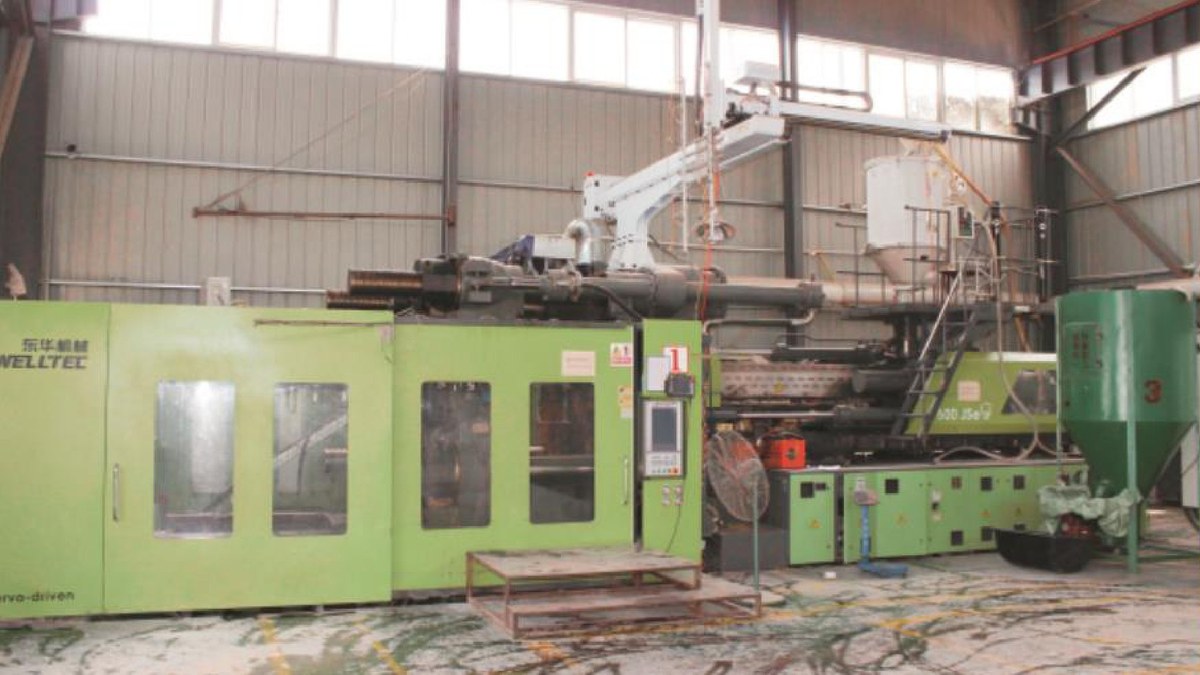
Injection moulding on the plastics line — where the component parts of a farrowing place are formed, to a tolerance set by the crate drawing.
On 20 October the National Bureau of Statistics published two numbers that do not normally belong in the same sentence. At the end of the third quarter China held 36.02 million breeding sows — down 4.33 million head, or 10.7%, year on year, and 4.7% lower than at the end of June. In the same nine months the country produced 45.08 million tonnes of pork, up 3.2%. Fewer sows, more pork.
That divergence is the entire story of the industry this year, and it is not a statistical artefact. Slaughter ran to 53.74 million head in the nine months, up 1.4%, while total pig inventory fell 2.6% to 425.3 million. The herd is genuinely contracting. Output genuinely is not.
The mechanism sits in one figure: pigs weaned per sow per year. Industry average PSY has moved from roughly 18.3 in 2021 to the mid-twenties today, with the largest producers reporting 29 to 32. Each point of that gain is a pig that has to be born somewhere, weaned somewhere and moved somewhere — and the somewhere is a farrowing place that already exists.
The arithmetic nobody puts in a price report
Take the national breeding herd at 36.02 million sows and add one weaned piglet per sow per year. That is 36 million extra pigs — about five per cent of national output — produced without a single new sow and without a single new finishing place.
Now look at what that costs in buildings. At 2.2 to 2.3 litters per sow per year, 36.02 million sows produce some 81 million farrowings annually, or roughly 222,000 a day. A farrowing place that turns every 42 days — five days of entry and settling, 28 days of lactation, nine days of wash-down and drying — turns 8.7 times a year. Divide one into the other and the national farrowing estate comes out at about 9.3 million places.
Every one of those places is now carrying more pigs per turn than it was designed for. That is the quiet consequence of a decade of genetic and management gains: the bottleneck in a Chinese pig enterprise has moved out of the sow herd and into the room where the sows give birth.
The crate was specified for a different animal
A farrowing crate layout from fifteen years ago was drawn around a litter of ten or eleven. The sow was 200 kilograms, the litter averaged 1.5 kilograms at birth, and the creep area was sized to hold the piglets while the sow lay down.
Today's litters wean at 13, 14, sometimes 15. Birth weights have risen with litter size pressure, and the sow is heavier. Nothing structural changed to absorb that — the crate got the same internal width, the same slat gap, the same creep zone, and the same heat source. The extra four piglets per litter are being absorbed by the building's tolerance, not by its design.
A crate built for eleven piglets does not fail at fourteen. It just loses two of them slowly, in the corner nobody measures.
This shows up first as pre-weaning mortality, then as weaning weight spread, then as the tail of the batch that never catches up. All three are expensive, and none of them appear on an equipment quotation.
Turn rate is the cheapest capacity in the industry
At RMB 9.40 a kilogram on 24 October — down 20.6% year on year — and a pig-to-grain ratio of 4.25:1 against a 5:1 warning line, nobody in China is building new capacity. The ministry's own target of 37.5 million sows puts the current herd at 96% of normal, and the green band is 92–103%. The state has been explicit that it wants the herd where it is.
So capacity has to come from turns. Shorten the farrowing cycle from 42 days to 35 — 21-day weaning instead of 28, with the same five days in and nine days out — and a place turns 10.4 times a year instead of 8.7. The same national estate then holds 7.8 million places' worth of output instead of 9.3. That is 1.5 million places of capacity released without a yuan of capital, roughly a sixth of the entire farrowing estate.
It also costs something. Early weaning shifts cost into the nursery, into feed and into piglet health, and it only works if the crate is clean and dry enough to be turned in nine days rather than fourteen. The turn rate is not a management decision made in an office. It is a property of the floor.
Why a dry floor is a throughput asset
Turnaround time is set by how long it takes a house to dry. A slat run that holds moisture in the surface, or in a seam, holds the whole room out of production for days it did not need to lose. On a 42-day cycle, three days of extra drying is seven per cent of national farrowing capacity — the same seven per cent that took a decade of genetic selection to win.
The properties that shorten drying are unglamorous: a dense, non-porous surface that urine does not soak into; a low thermal expansion coefficient so panels do not open seams at the ends of the house; edge detail that survives a pressure washer without spalling into a porous core. Our BMC composite is rated at 20+ years indoors, retains around 80% of its strength after ten years of outdoor exposure, and moves at 1.3–1.5 ×10⁻⁵/K — five to ten times less than a thermoplastic slat. On a farrowing floor, all three of those numbers are throughput numbers before they are durability numbers.
Four things that decide a farrowing room's real capacity
- Creep area, measured not assumed. The piglet zone has to hold the litter the sow actually weans, at the weaning weight the nursery actually receives. Count square metres per piglet at day 21, not at day one.
- Slat gap and surface. Narrow enough to hold a 1.2 kg piglet, open enough that the floor is dry by the time the room is washed. Those two requirements pull in opposite directions, and the resolution is in the section, not the gap alone.
- Heat at the floor, not in the air. A composite heat panel under the creep holds the microclimate the ventilation is deliberately keeping cool elsewhere. Warm air over a cold slab is a piglet lying on its siblings.
- Wash-down and drying as one system. The clock on turnaround starts when the last pig leaves, not when the crew arrives. Drainage fall, a drying room and an airlock for boots decide whether nine days is achievable or aspirational.
What to send a supplier
Six things turn a farrowing quotation from a catalogue figure into a throughput calculation:
- Sows farrowing per week at design occupancy, and how that number is expected to move over five years.
- Current weaned pigs per sow per year, and the target.
- Weaning age and the wash-down interval the site actually achieves.
- House dimensions, beam spacing and whether the room can be emptied in sections.
- Water volume and power available at the site, and the drainage fall as built.
- The date the room has to be back in production — and whether the site can run at reduced farrowings during the changeover.
What this cycle is actually asking for
Fourteen consecutive months of losses have done what a decade of policy could not: they have made Chinese producers treat efficiency as a survival line rather than an aspiration. The result is a national herd that is smaller, more productive, and structurally short of farrowing places that can keep up.
At RMB 9.40 a kilogram, no equipment purchase turns a loss into a profit. What a correctly sized farrowing place does is convert one of the industry's few remaining gains — pigs per sow per year — into pigs actually weaned, rather than into pre-weaning mortality and weaning weight spread. In a market where the herd is capped and the price is not coming to the rescue, that conversion is the business.
Written by the KeMuHua engineering team · Xinxiang, Henan
All articles