Journal/Feeding
Cutting feed waste by 5–10% with a trough redesign
Feed is the largest line item on any pig farm. A change of 40 mm in trough geometry moves it more than most nutrition plans.
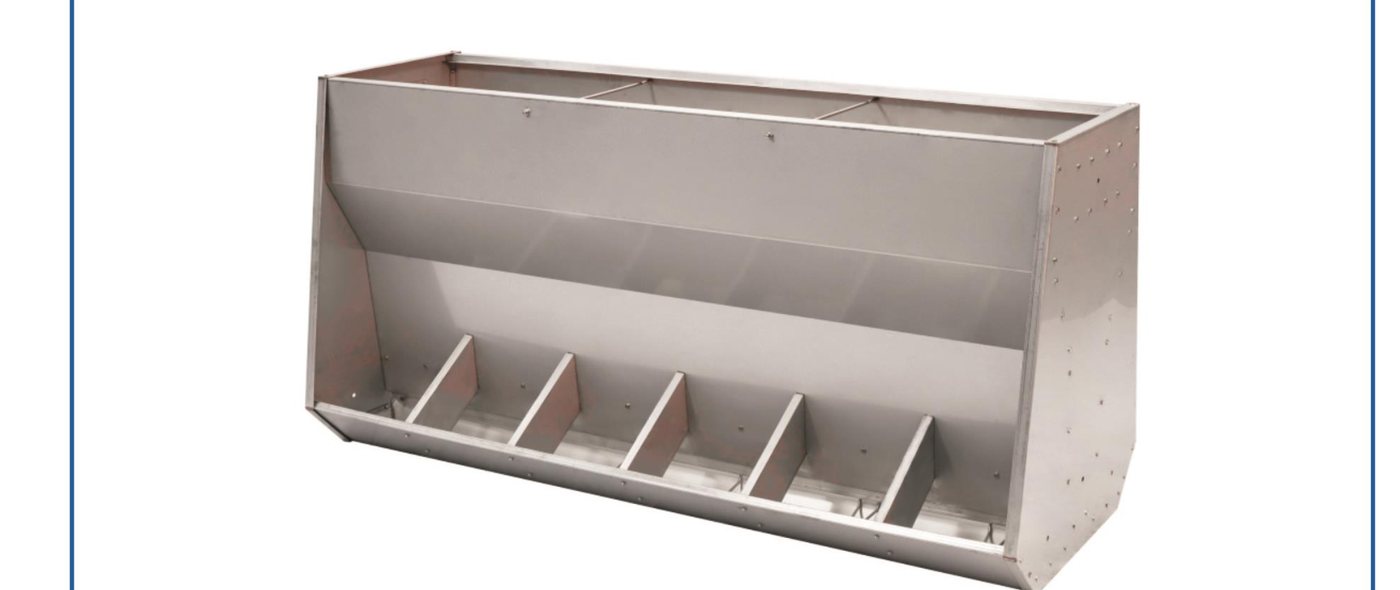
Double-sided 201-grade stainless trough, 1.2 mm sheet.
On a finishing unit, feed accounts for roughly 60–70% of the cost of a kilogram of gain. Nutritionists spend careers chasing two or three percent of feed conversion. The trough in front of the pig quietly gives away five.
Where the feed actually goes
Waste in a pig house is rarely a single dramatic loss. It is three small ones running at the same time:
- Scattering at the lip. Pigs root and sweep. Feed that clears the trough edge lands in the slurry channel and is gone.
- Uneven intake within the pen. If the feeding face is narrow, dominant animals hold the centre and the rest eat later, faster and messier.
- Spoilage of damp leftovers. Feed that sits wet against a corner cakes, sours and is refused — and it contaminates the next delivery.
The geometry problem
A conventional trough presents a narrow feeding face at a shallow angle. Feed sits in the middle rather than settling toward the animals, so pigs push it around to reach it. Every push is a chance to push it out.
Our patent ZL2024207141902 addresses the section rather than the material. The feeding area is widened and the feed-surface angle is set so that the ration settles toward the animal, not the aisle. The result is that a pig eats from a stable heap at its own feet instead of chasing a moving pile.
Widen the feeding face by 40 mm and the pen stops competing for the same square centimetres.
The interior is smooth and free of protruding fasteners, because the second half of the waste problem is cleaning. A trough that takes four minutes to scrape gets scraped properly; one that takes twelve does not.
Measuring it on your own farm
You do not need a research pen to check this. Run the same three measurements for two weeks before and after any change:
- Weigh feed in at the silo and weigh refusals out at the trough. The difference, against recorded gain, is your real conversion.
- Track pen-level variance, not house average. Uniformity is where the hidden loss lives.
- Inspect the trough floor 24 hours after feeding. Caking means the geometry is holding feed where the pig cannot reach it.
Match the trough to the stage
A nursery trough and a finishing trough solve different problems. Nursery animals need a shallow reach and a low lip so they can find feed in the first hour after weaning. Finishing animals need volume and a robust lip, because a 110 kg pig leans on everything.
Getting this wrong at either end of the cycle costs more than the trough. We size troughs to the weight class first, then to the pen layout, and only then to the budget.
Written by the KeMuHua engineering team · Xinxiang, Henan
All articles