Journal/Industry
The herd stopped growing. The capex did not.
China has cut its sow target to 37.5 million and Europe's spring census shows the pig herd contracting. The money has not left the building — it has moved to the barns already standing.
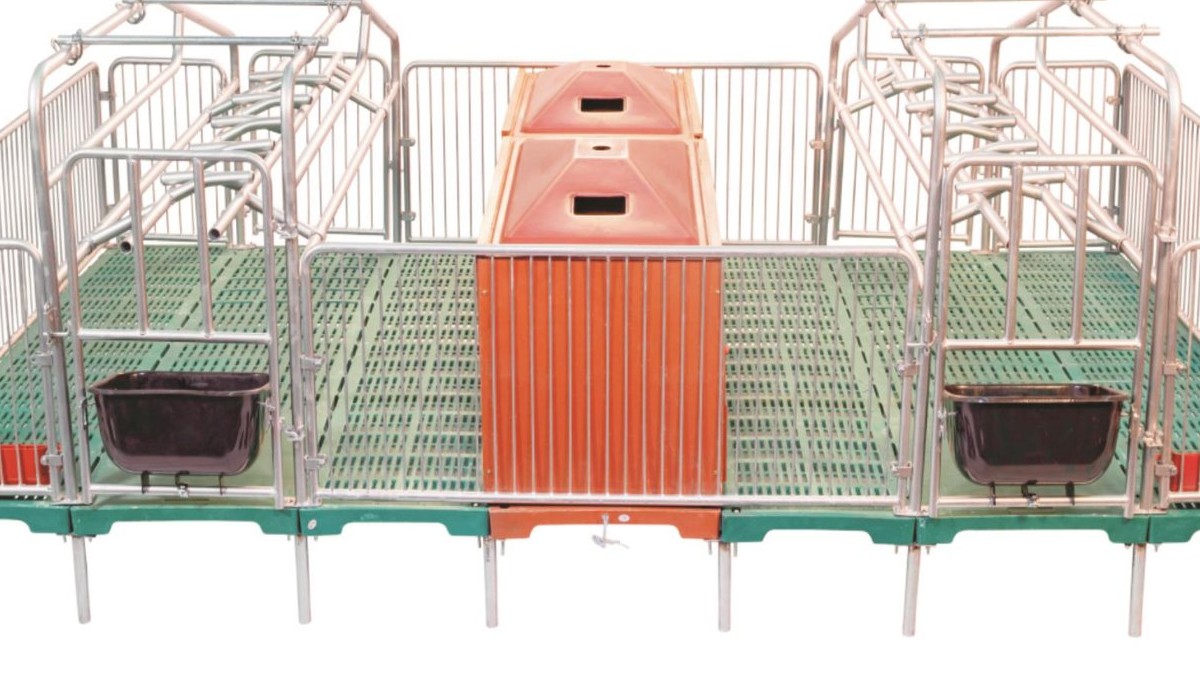
A two-crate farrowing module: penning, composite slat, stainless trough and feeder assembled and tested before dispatch.
Two documents published this year, five months and one continent apart, describe the same shift. In May, China’s Ministry of Agriculture and Rural Affairs revised its national sow target down to 37.5 million head. In October, Eurostat’s spring livestock census put the EU pig herd at 100.1 million across the eleven member states reporting — a fall of 1.0% — with the sow population flat at 7.82 million.
Neither number is a collapse. Both say something more useful: the herd has stopped being a growth story. For anyone who buys or specifies equipment for livestock buildings, that changes the question being asked.
What the two markets actually did
China’s revision is the more explicit of the two. The 2026 plan cuts the normal sow inventory from 39 million to 37.5 million, holds the national count of large-scale farms above 130,000, and pulls every group holding more than 100,000 sows into a national monitoring list with annual production filing. It also narrows the green band to 92–103% of target — a tighter corridor than before, which means intervention now comes earlier in both directions.
The effect showed up within a quarter. By the end of Q2 the national sow herd stood at 37.8 million, back inside the band, and farmgate prices recovered above RMB 11 per kilogram after a long stretch of industry-wide losses.
Europe is running the same correction without a central planner. Spain, the largest producer, counted 33.10 million pigs, down 2.0% — yet its sow herd rose 2.6%. The Netherlands fell hardest, down 6.8% in pigs and 5.7% in sows. Denmark added pigs (+2.5%) while trimming sows (−0.9%) for the first time in years. Germany and Poland were close to flat. The European Commission expects EU slaughter to run below last year’s level through the second half.
Read the national totals and you see contraction. Read the country detail and you see something else: sows are being consolidated onto fewer, better sites while the total breeding base holds. That is a renovation signal, not an exit signal.
Why a flat herd moves capex instead of cancelling it
When a producer cannot add pig places, the margin has to come from the places he already has. On a standing farm there are only three levers, and all three are equipment decisions:
- Feed conversion. Feed is 60–70% of the cost of a kilogram of gain, and the trough is where a fraction of it is quietly given away.
- Labour hours per pig. Every manual scrape, every feed round walked, every minute of wash-down.
- Replacement cycle. A floor that lasts twenty years instead of twelve is eight years of depreciation that never has to be funded again.
None of these is a capacity decision. All of them are locked in at the point of purchase, and all of them can be changed inside a house that is already standing.
The number to argue about is cost per pig place per year
New-build quotations are normally compared on cost per pig place. It is a clean number and, for a retrofit, the wrong one — two barns with the same capital cost can differ by a decade in how often the floor, the trough and the fan bank have to be replaced.
Divide installed cost by the service life you are actually prepared to warrant, then add the annual feed and labour loss. That is the figure that survives a down-cycle, and the only one that compares a cheap panel against an expensive one honestly.
A retrofit is judged by how few days the house stands empty.
What that does to the specification
Floor first, because it is the one item you cannot revisit. Every other system in the house can be swapped between batches. A slat run cannot — replacing it means emptying the building. So the panel’s service life sets the renovation interval for everything sitting on top of it. Our BMC composite is rated at 20+ years indoors, retains around 80% of its strength after ten years of outdoor exposure, and moves at 1.3–1.5 ×10⁻⁵/K — five to ten times less than a thermoplastic slat. On a retrofit that last figure matters twice over: less movement means the new panels fit a frame that is already in the ground.
Trough second, because it pays back fastest. Patent ZL2024207141902 widens the feeding face by 40 mm and angles the feed surface toward the animal rather than the aisle. On a finishing unit that is worth an estimated 5–10% of feed — and unlike a floor, a trough can be changed pen by pen, between batches, without touching the structure.
Climate third, and count the inlets before the fans. Most of the under-ventilated houses we are called out to already have the right fan bank. What they lack is inlet free area, so the house cannot hold 10–25 Pa and the incoming air drops onto the animals instead of travelling along the ceiling. A retrofit that adds fans to that house makes it worse, not better.
Manure last, sized on the wash-down day. Separation capacity is conventionally sized on average daily flow, and it fails on the day three houses are washed at once. Set the buffer for the peak, then choose the machine.
The sequence we would run
- Measure the house as it stands: beam spacing, clear height at the end wall, actual inlet free area, static pressure with the building closed.
- Set the target as a return per pig place per year — not as a purchase price.
- Fix the floor life first, because it sets the interval for everything above it.
- Then troughs, climate and manure — each sized against the house you measured, not the catalogue you were shown.
What to send a supplier
Six things will turn a retrofit quotation from a guess into an engineering answer:
- Species and stage mix, and the number of places by stage.
- Existing beam spacing and house dimensions, end to end.
- Whether the house can be emptied in sections or only all at once — this decides the whole phasing plan.
- Water volume and power available at the site.
- The current static pressure and inlet free area, if anyone has measured them.
- The date the house has to be back in production.
None of this is exotic. It is simply the difference between a supplier quoting a product and a supplier quoting a renovation — and in a year when the national herd is being told to stand still, that difference is most of the value.
Written by the KeMuHua engineering team · Xinxiang, Henan
All articles