Journal/Export
The pork left first. The barns are following.
China exported 81% more pork in the first half of 2026 and 28.8% less came in. The trade that follows the meat is the building it was raised in — and a barn specified for Henan is not a barn specified for the Mekong.
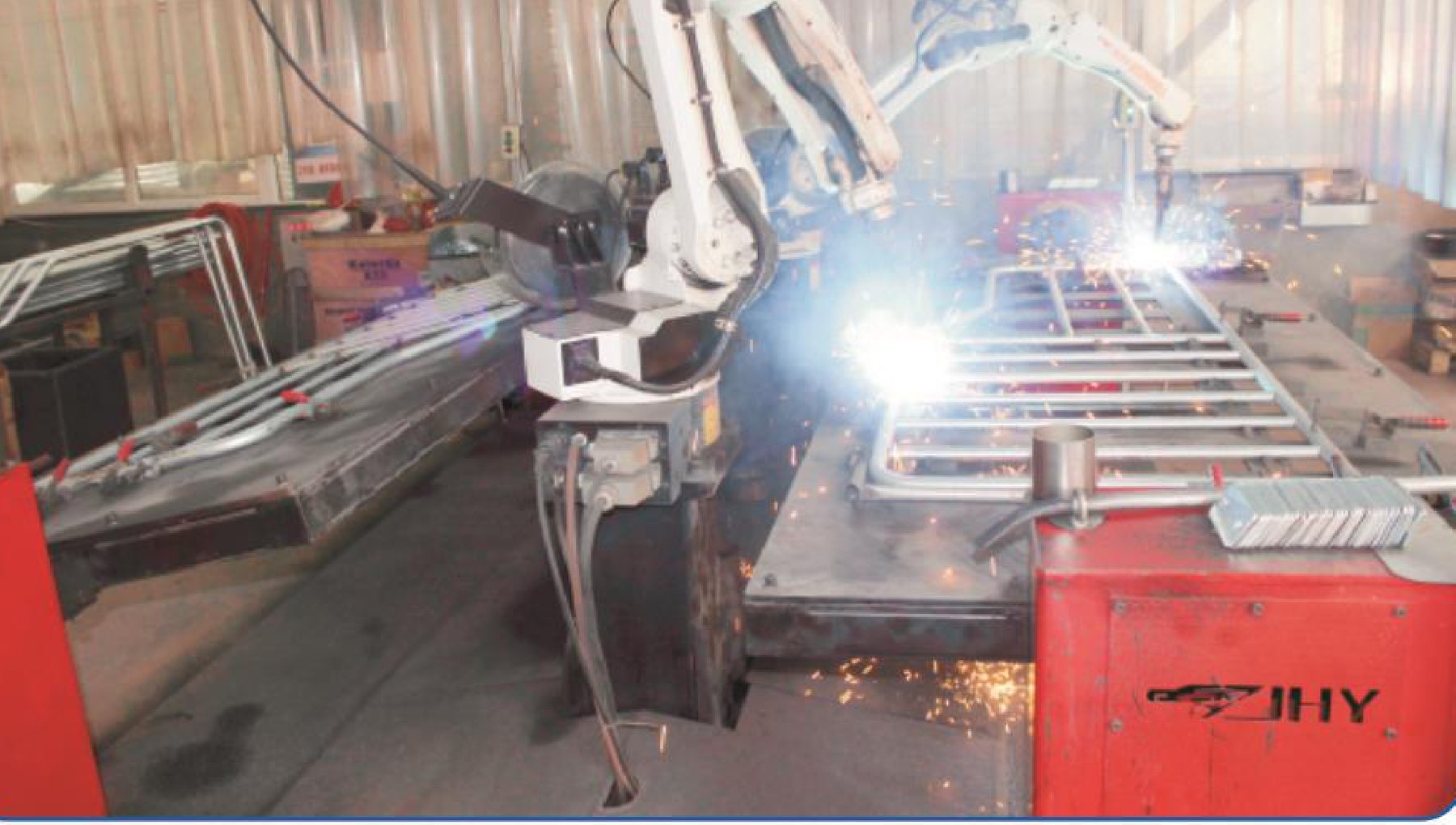
Robotic welding of pen frame sections at the Xinxiang base — the joint that decides whether a crate survives fifteen years of wash-down and ammonia.
In the first half of 2026 China imported 382,600 tonnes of pork — down 28.8% year on year, the twelfth consecutive monthly decline — and exported 32,200 tonnes, up 81.1%. That is twenty months of export growth in a row, and a half-year total larger than the whole of 2022, 2023 and 2024 combined. Set against 45.08 million tonnes of domestic output it is still a rounding error. It is also the visible edge of a trade that is moving in the same direction one layer down.
On 12 September Muyuan's first wholly-owned overseas farm cleared investment approval in Gia Lai, Vietnam. The numbers are not small: RMB 1 billion, 112 hectares, a 50-year land right, 16,200 breeding sows, 209,000 finishing places per batch, 2.17 turns a year, roughly 450,000 head of annual output, and a 360,000-tonne feed mill on the same site. Construction is due to start this month on a twelve-month programme, with first pigs in the first quarter of 2028. Four months earlier the company's joint venture with BAF had commissioned a multi-storey building farm in Tay Ninh — 125,000 head a year out of a single building, on the way to a 1.6 million head base.
Neither of those is a pork export. Both are a pen layout, a ventilation design, a floor specification and a structural frame, exported as a package. The meat is the small print. The building is the order.
The gap is about RMB 390 a head, and it is already closing
On 25 October the Chinese national average for lean hogs was RMB 9.48 a kilogram, down 19.9% year on year and 9.2% on the month. In Vietnam, live hog prices in mid-October ran at VND 50,000 to 53,000 a kilogram — around RMB 13 at 3,870 dong to the yuan. On a 100-kilogram pig, that is a gap of roughly RMB 390, before a single kilogram of feed is counted.
It would be a mistake to read that gap as a permanent subsidy, and the same price series says why. Vietnamese hogs traded at VND 56,000 to 58,000 in mid-August and around VND 59,000 to 60,000 in the north by mid-September. They have fallen about 14% from that peak in a month, on softer demand, heavier forward selling and rising pork imports. In the same window a 566,000-head project from THACO Agri cleared approval in Gia Lai — the same province as Muyuan's new farm — with BAF, Hoa Phat and De Heus all expanding. Vietnamese commentary has begun using the word overcapacity.
A price gap is a reason to move. It is never a reason to specify badly — because the specification outlives the gap.
That asymmetry is the whole argument for how an export barn should be bought. The margin that justifies the project will be gone in a year or two. The galvanising, the fan bank and the floor will be there in fifteen.
A herd that is smaller and produces more
Vietnam's pig sector is running China's 2018 script with a seven-year lag. Between 2018 and 2024 the national herd fell from 28.2 million head to 26.5 million, and pork output rose from about 3.8 million tonnes to 5.18 million — up 36%. Fewer animals, more meat. That is the same efficiency divergence China published for its own third quarter, and it produces the same consequence: the constraint moves off the sow herd and onto the buildings.
African swine fever is doing the restructuring. More than 115,000 pigs have been lost to the disease in Vietnam during 2026, and the losses are concentrated in smallholdings, which exit and do not come back. The replacement capacity is being built by integrators, at scale, on land that costs too much to spread out on. Hence the multi-storey building — not an architectural preference, but the only way to put 16,200 sows within reach of a feed mill and a road.
A building changes the equipment brief in ways a shed never did. Load paths go into a slab and a frame rather than into the ground. Manure leaves by belt and by pump, not by scraper to an outdoor channel. Air is ducted, because there is no roof void to use as a plenum. Every one of those is a specification the supplier has to be able to write, not just quote.
What changes 1,900 kilometres south
The distance from Xinxiang to Tay Ninh is about 1,900 kilometres, and the climate difference is larger than the distance suggests. A Henan barn is designed around a 12 K winter-to-summer swing, a dry spring and a snow load. A Mekong barn is designed around 30 °C every day of the year, 80 to 85% relative humidity for months, and a wind load from the other direction entirely. Four things change.
Corrosion stops being a maintenance item
Zinc corrodes faster in warm, wet, ammonia-bearing air, and the rate roughly doubles for every 10 K of temperature. A pen frame in a Henan house sits in an atmosphere that is aggressive for part of the year. The same frame in a tropical house sits in it permanently, in a building where the pit is never cold enough to slow the reaction down, and within salt-air reach on a coastal site. Under ISO 9223 that is a C4 environment at least, and C5 near the coast.
"Hot-dip galvanised" is not a specification. Coating mass is. Under ISO 1461 a 3 mm section must average 55 µm, with no single reading below 70; a 6 mm section must average 70, with none below 85. Thicker steel holds more zinc because it stays longer in the bath. On a C4 site with a fifteen-year horizon, the second number is the one that matters, and it has to be written into the purchase order along with the batch test certificate — average and local minimum both, and in g/m² as well, since that is the unit the corrosion tables are written in. Stainless fixings stop being an upgrade and become the only option: a galvanised anchor is the first thing to fail, and it fails inside the slab where nobody sees it.
You cannot cool tropical air by evaporating into it
This is the technical heart of the difference, and it is arithmetic. Air at 30 °C and 50% relative humidity carries about 64 kilojoules per kilogram of dry air. The same air at 30 °C and 85% relative humidity carries 89. The temperature is identical; the heat content is 38% higher. A cooling pad works by evaporating water into that air, and at 85% RH there is very little room left for it to evaporate into. The pad becomes a wet wall with a fan behind it.
So the cooling has to come from air speed and air exchange rather than from refrigeration or evaporation. In practice that means tunnel ventilation sized for the air speed the weight class needs at the design maximum — typically 2.5 m/s for finishing pigs, less for weaners and sows — and inlet area sized to the fans rather than to the wall, the failure mode we have written about before, arriving in a climate where it is expensive. It also means the fan bank is not a summer peak item. In the tropics it runs most of the year, so fan power becomes an operating cost line and impeller efficiency becomes a purchasing criterion rather than a footnote.
There is a second consequence. At 30 °C a finishing pig sheds most of its heat as water vapour, not as sensible heat. Ventilation in that climate is therefore doing moisture removal as its primary job. Air changes per hour is the wrong metric; kilograms of water per hour is the right one.
The roof is a different product
In Henan you insulate a roof to keep heat in. In the Mekong you insulate it to keep radiant load out, from a metal surface that reaches 55 to 60 °C by mid-morning, and you do it with a reflective underside and a ventilated cavity rather than with a thicker blanket. Same product family, opposite design point. A barn specified from a northern template will be over-insulated and under-reflective, and it will run hot at the ceiling all year.
The structural load case is not the one you designed for
A Henan frame is checked against a basic snow pressure around 0.35 kN/m². That load does not exist in Vietnam. What exists instead is wind — a design gust pressure several times that figure in exposed provinces — and on a light steel roof the governing case is uplift, not gravity. A frame carried over from a Chinese template is typically over-built for the load it will not see and under-specified for the one that removes roofs, which is the worst of both: you pay for steel you do not need and still lose the building in a storm. This is a question to put to the supplier in writing, with the design code named.
The container is part of the design
A farrowing crate is a volume product. It is mostly air, packed around a frame, and the freight on that air is charged by the cubic metre. On a 40-foot high-cube, nesting geometry decides whether a house fits in nine containers or seven, and that difference is larger than most ex-works price negotiations.
It is also a manufacturing question, not a packing question. Panels designed to bolt together on site can ship flat and dense; panels welded as a rigid assembly cannot. That is why the frame in the photograph is robot-welded as a flat section and assembled later — the tolerance is set in the jig, and the volume is set in the container. A supplier who quotes a crate price without a packing plan is quoting half a delivered cost.
The other half of the same problem is site tolerance. A building farm in the tropics is assembled by a crew that has never built one, on a slab poured by someone else, to a schedule measured in weeks. Bolted connections with slotted holes forgive a 10 mm setting-out error. Welded connections do not. On an export project the joint design is a schedule decision before it is an engineering one.
What to put in an enquiry
Six items turn an export quotation into something a project can be built from:
- The corrosivity category and the distance to the coast. ISO 9223 C3, C4 or C5, with the coating mass you expect — in g/m², not "hot-dip".
- The design code and the governing load case. Wind speed and uplift, not snow.
- Design dry-bulb and relative humidity for the worst month, plus the altitude of the site. Enthalpy and fan sizing both follow from those three numbers.
- Whether the house is single-storey or in a building, and if a building, the slab level and the ceiling height available for ducting.
- Container count and the port of discharge. Packing density is a design input; ask for it before the order, not after.
- Who assembles, and to what tolerance. If the answer is a local crew, ask for the connection detail and the shim allowance.
Why this is the trade that matters
Chinese agricultural machinery exports ran to RMB 49.4 billion in the first eight months of 2026, up 7.4% — a slower year than 2025's 32.3% growth, and a flat August. Exports to Vietnam reached USD 451 million in 2025, up 36%. Livestock housing does not appear in those figures as a separate line, which is exactly why it is worth watching: it is the part of the trade that carries a specification with it.
At RMB 9.48 a kilogram, with fourteen months of losses behind the industry and a sow herd the state wants held where it is, the domestic market cannot fund new capacity. The export order book is where a Chinese equipment manufacturer's engineering gets paid for. That raises the standard rather than lowering it. A barn built in Tay Ninh to a C4 coating specification and a tropical enthalpy load is a better barn than the one it replaced — and the crew that builds the next one will ask for the same numbers.
Written by the KeMuHua engineering team · Xinxiang, Henan
All articles