Journal/Biosecurity
One vehicle in 333 tests positive. The wall decides whether it gets in.
African swine fever vehicle samples come back positive 0.3% of the time, and 80% of infected pigs are first found on the slaughter truck. At RMB 308 of loss per head, a RMB 150,000 retrofit around a RMB 1.2 million yard is the only capital project still returning anything — and it begins as a drawing, not a product.
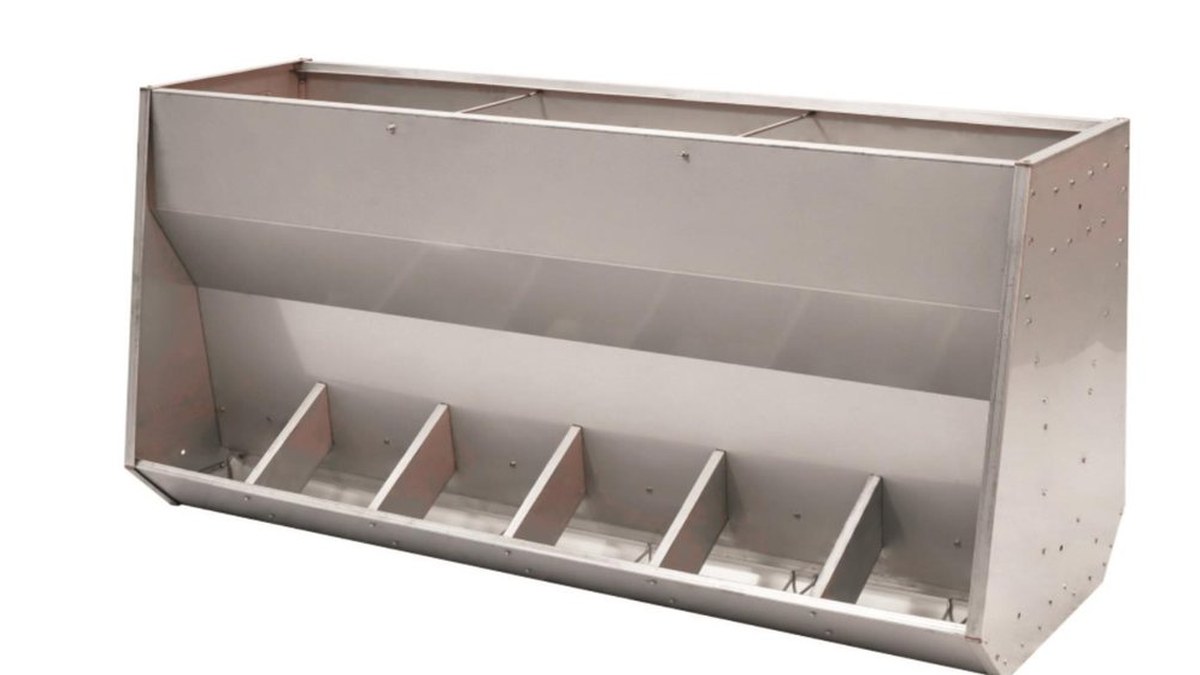
A 201-grade stainless trough on an open bracket at the Xinxiang plant — the detail that decides whether a surface is still cleanable in year three.
On 25 October the national average for lean hogs was RMB 9.48 a kilogram — down 19.9% on the year and 9.2% on the month. The price centre at the National Development and Reform Commission put the national pig-to-feed ratio at 3.92 in the first week of October, which works out at a loss of RMB 307.94 on every pig finished from a weaner. In that market the advice circulating in Chinese farm media this week is not about price. It is about a wall. Spend RMB 150,000 on a fence, a loading dock and a wash bay, the argument runs, and you protect a yard worth RMB 1.2 million. The ratio is seven to one and it is easy to sell. The number that actually carries the argument is smaller and harder: 0.3%.
That is the share of vehicle samples that test positive for African swine fever virus in the national surveillance record — 0.3% for vehicles, 0.27% for people, 0.22% for materials, out of 2.1 million samples analysed by the national ASF regional laboratory in Guangzhou. It sits alongside a finding from the industry's own post-mortems of more than a hundred infected farms: entry was exogenous in essentially every case, and 80% of the pigs that eventually tested positive were first detected on the slaughter truck.
Read as a ranking, those three numbers are unremarkable. They are all about a third of one per cent, and the gap between first and third sits inside the noise of the sample count. Read as a budget, they are an instruction. The two most likely ways a virus enters a yard are a truck and a person, and neither is stopped by a sprayer. They are stopped by where the wall runs, where the dock sits, and whether the shower is on the correct side of both.
The boundary tests positive. The barn does not.
The surveillance record is worth reading for what is missing from it as much as for what is in it. Pen surfaces, troughs and slats inside a well-run house rarely appear among the positives. What appears is the perimeter: the truck, the driver, the feed bag, the loading bay, the market. The virus does not walk into a barn. It is carried across a line, and the line is a piece of construction.
The strain picture makes that line more important rather than less. The dominant field virus in China is now a natural recombinant between genotype I and genotype II — twenty genome segments, ten from each parent, 44% and 56% — circulating alongside MGF and CD2V deletion strains and naturally attenuated isolates. The clinical picture is atypical: a low fever that responds to treatment and comes back, a few animals off feed, patchy lesions at the ear tips and flanks. It is easily mistaken for PRRS. Atypical disease is harder to see, which means the detection that used to happen in the pen now has to happen at the gate, before anything is inside.
The geography does not help. Regional outbreaks began in Jiangxi in late July and spread through August, falling hardest on small and medium farms. Globally, 28 countries reported more than 6,580 outbreaks and 64,700 infected pigs between January and July. The three recurring hotspots in the Chinese record are small and medium farms, wet markets and live-haul vehicles — and only one of those three is something a farm can control.
Biosecurity is not a device you install at the gate. It is the drawing that decides where the gate is.
There is also no vaccine to wait for. No ASF vaccine is licensed in China. The recombinant subunit candidate has completed trials in more than 10,000 pigs and two challenge rounds and is in pre-registration, with approval forecast no earlier than 2027. Vietnam is the cautionary case: its licensed live vaccine was matched to older strains, while 83.6% of the strains now circulating in the country are recombinants. Biosecurity is not a bridge to a vaccine. It is the structure, and the structure is capital.
RMB 150,000 against RMB 1.2 million
The cost side of the argument is more solid than it usually sounds, because it can be built from published unit prices rather than a supplier's quote. Zhejiang's Songyang county published a schedule for disease-control works that is still the trade reference: RMB 200 a metre for a solid perimeter wall, RMB 3,000 for a loading dock, RMB 2,700 for a shower room, RMB 3,000 for a gate, RMB 1,000 for a high-pressure washer. A thousand-head finishing yard with 400 metres of perimeter is RMB 80,000 of wall before anything else is bought. Add the dock, the shower, the disinfection room and a washer, and the total lands near RMB 150,000; the “iron barrel” repopulation programme run by Yangxiang put a 1,000-head yard at about RMB 200,000 including the internal rework.
Against a yard holding 1,000 head at 120 kilograms on a 9.7 yuan market — roughly RMB 1.16 million of live inventory — that is a seven-to-one ratio. The ratio is not the interesting part. The interesting part is how thin the probability has to be for the spend to pay.
Our own estimate, with the assumptions stated. A thousand-place finisher at 2.4 turns a year moves about 110 vehicles across its boundary annually: 18 outbound loads of finished pigs, 21 inbound loads of feed at 30 tonnes, a dozen manure and mortality collections, the rest service, fuel and visitors. At a 0.3% positivity rate that is 0.33 contaminated vehicle contacts per year, or one and a half over a five-year building life. If a contaminated contact infects the yard one time in ten, expected outbreaks per building life are 0.16. At one in two, they are 0.8. Multiply by the value at risk and the retrofit is worth between RMB 190,000 and RMB 930,000 in expectation, against a cost of RMB 150,000.
The model is deliberately crude, and it is worth saying where. It treats every contact as equivalent, ignores the people and material vectors that would add roughly as much again, and counts only the pigs — not the repopulation, the six to eight months of empty cash flow, or the customer relationships that go with them. Its purpose is not precision. It is to show that the case does not have to be won by a wide margin. Priced against a loss of RMB 307.94 a head, the whole retrofit costs the loss on 487 pigs: half of one turn.
The other half of the argument is what a retrofit is not. It is not new capacity. Under the equipment-renewal window opened in March — RMB 1.2 trillion of re-lending, 1.5 points of interest subsidy for up to two years, applications through apfp.agri.cn — the eligible object is explicitly the existing building, and the clause that excludes expansion is the clause that makes a fence, a dock and a wash bay financeable. With the sow herd to be held near 37.5 million head, the only capital project with a return is the one that protects the herd already standing.
One virus particle per millilitre
The most under-designed line in a pig house is the one carrying water. The reason is a number that has been in the literature for years and has still not reached the drawing board: the minimum infectious dose of ASFV in drinking water is one TCID₅₀ per millilitre. In feed it is 10,000 per gram. Water is four orders of magnitude more efficient as a vehicle, and a pig drinks two to three times what it eats.
Survival is the second half. The virus persists at least 42 days in river water between 4 and 25 °C, 154 days in clean water at 4 and 15 °C, and 84 to 98 days at 25 °C when blood or faeces are present to protect it. A shallow well, a pond, a header tank topped up from a line shared with the yard wash point — none of those is a water source. They are a delivery system.
The design consequence is architectural, and it is cheap. A single header tank serving six houses is a fan-out device: one contamination event becomes six infected houses in the same afternoon, before anyone has a clinical sign to look at. Six break tanks and six independent loops are not six times the cost. They are one extra tank, five valves and a drawing that says which valve.
- Source. No surface water, no shallow well. Mains or a deep bore, cased and capped 300 mm above grade.
- Storage. Not less than 1.5 days of consumption, in a tank that can be drained and scrubbed, with a closed, bird-proof lid.
- Loop. One inlet, one valve and one meter per house. A shared riser is a shared risk, and it is invisible until it is not.
- Backflow. An air gap or a vacuum breaker — not a check valve. A check valve fails silently; an air gap fails visibly.
- Drainage. A low-point drain on every run, with the pipe falling toward it, so that a loop can actually be emptied and dried.
- Terminals. 304 stainless drinkers, anti-urine pattern in gestation, with 150 mm of clearance behind each one for a jet and a brush.
- Monitoring. Chlorine or ORP measured at the far end of the loop, not at the dosing point. The dosing point reads what you added; the far end reads what the pig drank.
Seventy degrees for thirty minutes is a materials test
The wash-down protocol now standard in the trade is a sequence, not a spray: dry clean, foam for 10 to 20 minutes, rinse at 60 to 80 °C, disinfect, dry, then hold at 60 to 70 °C for half an hour. The engineer who runs the Guangzhou laboratory puts the priority plainly — correct washing removes about 90% of the microbial load, and the disinfectant deals with the remainder. Which means the design question is not which chemical. It is whether a fan jet can physically reach every surface in the room.
Very little of what is sold as pig equipment is built for that cycle. Four failures recur.
Hot alkali eats zinc faster than weather does
A galvanised frame specified for fifteen years of ambient exposure is not specified for fifteen years of weekly caustic at 80 °C. Zinc consumption accelerates with temperature — roughly doubling per 10 K — and accelerates again above pH 12.5 and in the presence of chlorine. Cut ends, thread roots and weld spatter are where it starts, because that is where there is no coating at all. On a crate washed every turn the question is not “hot-dip galvanised” but the coating mass in g/m² and the batch certificate, read against a wash-down exposure rather than a rural one.
The panel core sets the temperature ceiling
An EPS-cored sandwich panel has a continuous service limit around 70 to 80 °C. A thirty-minute hold at 70 °C in a sealed room sits at the top of that range, and every cycle after it is a small debit against the panel's life. PIR moves the limit to roughly 120 °C for a modest premium. The same arithmetic applies to the fan: an orthophthalic polyester casing will chalk and blister under repeated hot alkaline wash, and a vinyl-ester resin will not — so the question for a fan supplier is not the airflow curve, it is the resin. Seals fail before either of them. NBR hardens and takes a set; EPDM and silicone do not.
The floor is not an epoxy floor
Epoxy blisters under hot alkali, and a blistered floor is a reservoir, not a surface. What survives the cycle is a hard aggregate finish, a fall of 1.5 to 2% to a trapped gully, and a coved junction at the wall so water leaves instead of standing. Slip resistance matters more than usual here: a wet, caustic, 70 °C floor is the most dangerous surface on the site, and it is the one the crew walks on twice a day.
Fasteners you can see, and panels you can lift
The last failure is the one nobody specifies. Welded lap joints trap water and cannot be inspected. Bolted frames with slotted holes come apart for washing and go back together with a two-man crew. The same logic applies to the trough — one that lifts off its bracket gets cleaned, one welded to the frame does not — and to the crate itself, where a removable front gate turns a fifteen-minute job into a two-minute one. This is the cheapest change on the list and the one that decides whether year-three hygiene resembles year one.
If a surface cannot be reached by a fan jet from within 600 mm, it will not be clean in year three, whatever the SOP says.
The dock is the only door that matters
Everything the ranking says about vehicles comes down to one detail: whether a truck crosses the line, and whether the people in it do. A dock built into the perimeter wall, with the ramp falling away from the yard at about 3% so run-off leaves the site rather than entering it, a 600 mm galvanised kick plate at the base and a gate that closes behind the last pig, converts an eighteen-tonne exposure into a handover at arm's length. The same dock built inside the yard is the same money spent to move the risk forty metres closer.
The wash bay is the other half, and its dimensions are set by the largest vehicle that will ever use it rather than the average one: clear length of vehicle plus 3 metres, 60 to 70 °C held for thirty minutes, distribution within ±5 K at the far end of the trailer, and a floor draining to a separator rather than to the yard. A dryer that is warm at the door and 45 °C at the back is a device for convincing an inspector.
The perimeter has published numbers too, and they are worth treating as a specification rather than a suggestion: mesh aperture no larger than 20 mm, height no less than 1.8 m, footings buried at least 300 mm. That 20 mm aperture doubles as a bird exclusion figure. The same order of number appears in rodent control — GB/T 27770 caps the path index at five traces per 1,000 linear metres outside, and the 2025 rodent specification for large farms wants positive bait stations under 5%. Bait stations belong outside the wall only, away from water and feed, because a station inside a pen is a poisoned pig waiting to happen.
The one route that is now a legal problem
Feed has never been the main route: of the 68 outbreaks whose pathway had been established by November 2018, none was traced to feed, while 62% of the first 21 were linked to kitchen waste. That last number has now moved from a risk to an offence. Since 15 August 2026 the Ecological Environment Code has prohibited livestock farms from feeding kitchen waste that has not been rendered harmless, with fines up to RMB 100,000, RMB 100,000 to 1,000,000 and closure in serious cases. The threshold for “farm” is a 500-head annual finish, per ministry announcement 927 — which is most of the yards this article is about.
The equipment consequence is easy to miss. A liquid-feeding kitchen was specified as a cost-saving device: swill in, wet feed out, a few yuan a head. It is now a regulated process room, and the obligation is not that the heat treatment happens but that it can be demonstrated — a documented hold at temperature, a batch record, a retained sample, and a tank that cannot be filled from the wrong door. A wet-feeding line that cannot produce that record has stopped being a saving. It is a liability with a capital cost attached.
What goes in the drawing set
Six items separate a retrofit that works from one that photographs well.
- The perimeter, dimensioned. Metres of wall, aperture, height, footing depth, and where the two gates are. A wall without a gate schedule is a fence.
- The dock, with the fall. Position relative to the wall, ramp gradient and direction, kick plate, and where the run-off is discharged.
- The water single-line diagram. Source, break tank, one loop per house, air gap or vacuum breaker, low-point drains, sampling points at the far end.
- The wash-down envelope. Which surfaces see 80 °C and which see 70, with the coating, core and seal specification for each — in g/m² and in °C, not in adjectives.
- The removable list. Every panel, trough and floor section a two-man crew can lift, with the fastener and the tool named.
- The record. Dryer temperature logs, chlorine at the loop end, bait station checks, and the batch that ties each of them to a date.
Why the structure outlives the price
At RMB 9.48 a kilogram and fourteen consecutive months of losses, the temptation is to treat every yuan of capital as a bet on the next rally. Biosecurity is the one line item that is not. It protects an asset that exists today rather than financing one that might exist in 2028, it is the only category of work the loan window will actually fund, and its return does not depend on the market moving at all. It depends on a truck not crossing a line.
A yard that spends RMB 150,000 on a wall, a dock and a water main has not bought a product. It has bought a plan, and the equipment is what the plan is made of. That is a different kind of order from a container of crates — and it is the one where the supplier has to read a site drawing before writing a quotation.
Written by the KeMuHua engineering team · Xinxiang, Henan
All articles