Journal/Policy
RMB 1.2 trillion is now open to barns. New capacity is excluded.
In March the ministry folded livestock buildings into the equipment-renewal loan scheme: RMB 1.2 trillion of re-lending, 1.5 points of interest subsidy, and one clause that rules out growth. At RMB 9.44 a kilogram, that clause is the whole market.
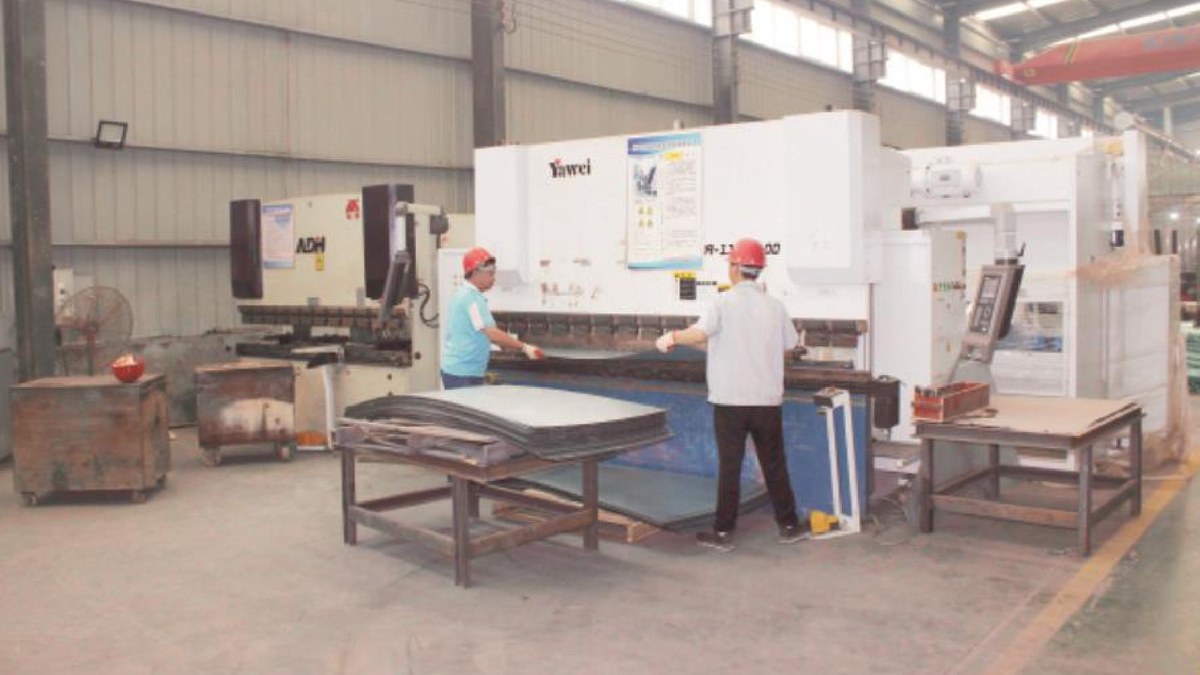
Press-brake work on galvanised frame sections — the line item the notice calls feeding and management facilities.
On 9 March the Ministry of Agriculture and Rural Affairs circulated a notice that few pig producers will ever read, and that now matters more than any price forecast. It folded facility agriculture into the equipment-renewal loan scheme and, in a single paragraph, defined what a livestock building has to look like to qualify. Seven months later the national average hog price sits at RMB 9.44 per kilogram, self-farrow-to-finish losses are running at RMB 323 a head, and the pig-to-grain ratio has stayed under the 5:1 break-even line long enough to hold a first-level oversupply warning. In that market, a credit line with a state subsidy attached is the most useful document the sector has.
The notice is short on rhetoric and specific about scope, which is rare enough to be worth reading closely. Here is what it pays, what it excludes, and where a barn retrofit gets rejected.
What the scheme actually pays
Stripped of the filing language, four numbers carry the policy:
- RMB 1.2 trillion of re-lending available from the People’s Bank to banks lending against projects on the approved list.
- 1.5 percentage points of interest subsidy from the central budget, applied to the principal of the fixed-asset loan.
- Two years — the maximum period the subsidy runs, whatever the loan tenor.
- 26 banks to which the list is pushed: 21 national institutions including CDB, ADBC and Agricultural Bank, plus five city commercial banks.
The first misreading to kill is that 1.5 points means the rate falls to 1.5%. It does not. On a loan priced at 3.2%, the subsidy takes the effective rate to roughly 1.7% for two years. On a RMB 3 million facility that is RMB 45,000 a year and RMB 90,000 in total — three per cent of the principal.
Three per cent is not the reason to do this. The list is. Being on it is what makes a bank willing to underwrite a barn in a year when the borrower’s entire sector has been loss-making for twelve months. The subsidy is the receipt; the access is the product. And the 1.2 trillion is a ceiling for the whole agriculture and rural portfolio, not a livestock allocation — the livestock share is whatever the candidate list produces.
The clause that defines the market
Inside the facility-livestock paragraph sits a sentence that shapes every project financed this way: in principle, expansion of pig production capacity is not supported.
Read it against the rest of the year. In May the ministry cut the national sow target from 39 million to 37.5 million and narrowed the green band to 92–103% of it. By the end of Q3 the national breeding herd had fallen to 36.02 million head, down 10.7% year on year and 4.7% on the quarter, with pig inventory at 425.3 million and pork output still up 3.2% — because each sow now weans materially more pigs than she did five years ago. A state actively shrinking its breeding herd is not going to subsidise new finishing places.
The scheme does not fund growth. It funds the difference between a barn that works and one that has merely been paid for.
The qualifier in principle leaves room to argue. It does not leave room to waste a quarter arguing. Any line that increases places reads as an increase in capacity, and capacity is the thing the notice was written to exclude. A project replacing 1,200 places with 1,200 better places is eligible. The same project carrying 1,400 is not.
What counts as an eligible line item
The categories follow the order in which a barn is actually built, which makes the mapping to a specification unusually clean:
- Structure — renovation of housing and penning: crates, stalls, nursery and finishing pens, the frame everything else hangs on.
- Feeding and management — feed lines, silos, troughs, wet-dry feeders.
- Environmental control — fans, inlets, cooling pads, insulation, heating.
- Disease control and disinfection — wash-down, footbaths, drying rooms, biosecurity airlocks.
- Manure collection and treatment — scrapers, belts, separators, storage, aeration.
- Feed processing and storage — milling, mixing, conveying.
- Automation — the controller layer that ties the above into one system.
Two conditions sit above the list. First, ancillary infrastructure — floors, drainage, power, water — must be planned and delivered as part of the same project as the equipment, not filed as a separate build. A barn slab quoted as its own line item stalls at the screen. Second, a principal already carrying the modern-facility-agriculture loan subsidy cannot claim this one too. The linkage is checked against the other programme, not taken on trust.
Why a two-year subsidy argues for a twenty-year floor
The subsidy is capped at two years while the assets it buys are not. That mismatch is the most useful filter available once an equipment schedule has to be cut to fit a budget.
Rank the candidates by service life and the answer is awkward for anyone selling climate kit. A BMC composite slat floor is rated at twenty years indoors. A hot-dip galvanised penning frame is a fifteen- to twenty-year asset. A fan bank is eight to ten. A controller is five to seven. A drinker line is a consumable. The subsidy pays two years of interest on all of them identically — so it buys most when it is attached to the longest-lived item in the building, and least when it is spent on something that will be replaced before the loan is retired.
That is the same conclusion the retrofit sequence reaches from the other end. The floor cannot be revisited without emptying the house, so the floor sets the interval at which every other system is renewed. Borrowing against it is borrowing against the one purchase that never has to be made twice.
There is a second-order trap. A producer who has just qualified for subsidised credit is a producer with a budget, and a budget invites the cheapest compliant panel. The subsidy is worth about three per cent of principal over its life; the gap between a twenty-year floor and a twelve-year one is nearer fifteen on the invoice, plus eight years of depreciation that never has to be funded again. Taking the cheap panel so the loan services comfortably is the one reliable way to lose money on a subsidised project.
How the filing actually runs
The route is a rolling list, not an application window. Projects are entered on the ministry’s major-project financing platform — apfp.agri.cn, policy-supported projects, equipment-renewal loan declaration — and screened upward level by level. What emerges is a candidate list, pushed on a regular cycle to the 26 banks. There is no single deadline to miss, which is precisely why there is no urgency signal strong enough to make anyone start.
For a retrofit, the sequence that survives screening looks like this:
- Measure the house and write the technical scope before speaking to a bank. A description that reads as a shopping list fails the compliance screen; one that names the deficiency being corrected passes it.
- Hold capacity flat — in the drawings and in the prose. Same places, better places.
- Put structure and equipment in one project, with civil works described as support for the equipment rather than as a separate build.
- Confirm no other central subsidy is already attached to the same principal.
- Fix the completion date before drawing the loan: the two-year subsidy clock starts at disbursement, not at approval.
The window, and what it is actually worth
None of this changes the arithmetic of a pig. At RMB 9.44 against a cost of production near RMB 11.5 for the best operators in the country, no interest subsidy turns a loss into a profit. What it can do is pull a renovation that would have happened in 2028 into the first half of 2027, at roughly half the market cost of capital, in the one year when the operator’s own cash flow cannot fund it.
That is a narrow window, and it does not stay open indefinitely. The producers who use it will be the ones already measuring their houses — and able to describe the deficiency in the language the notice uses, rather than the language of a catalogue.
Written by the KeMuHua engineering team · Xinxiang, Henan
All articles