Journal/Flooring
Why slat geometry decides your replacement cycle
Four failure modes quietly retire a slat floor years before its warranty expires. Only one of them is about the material.
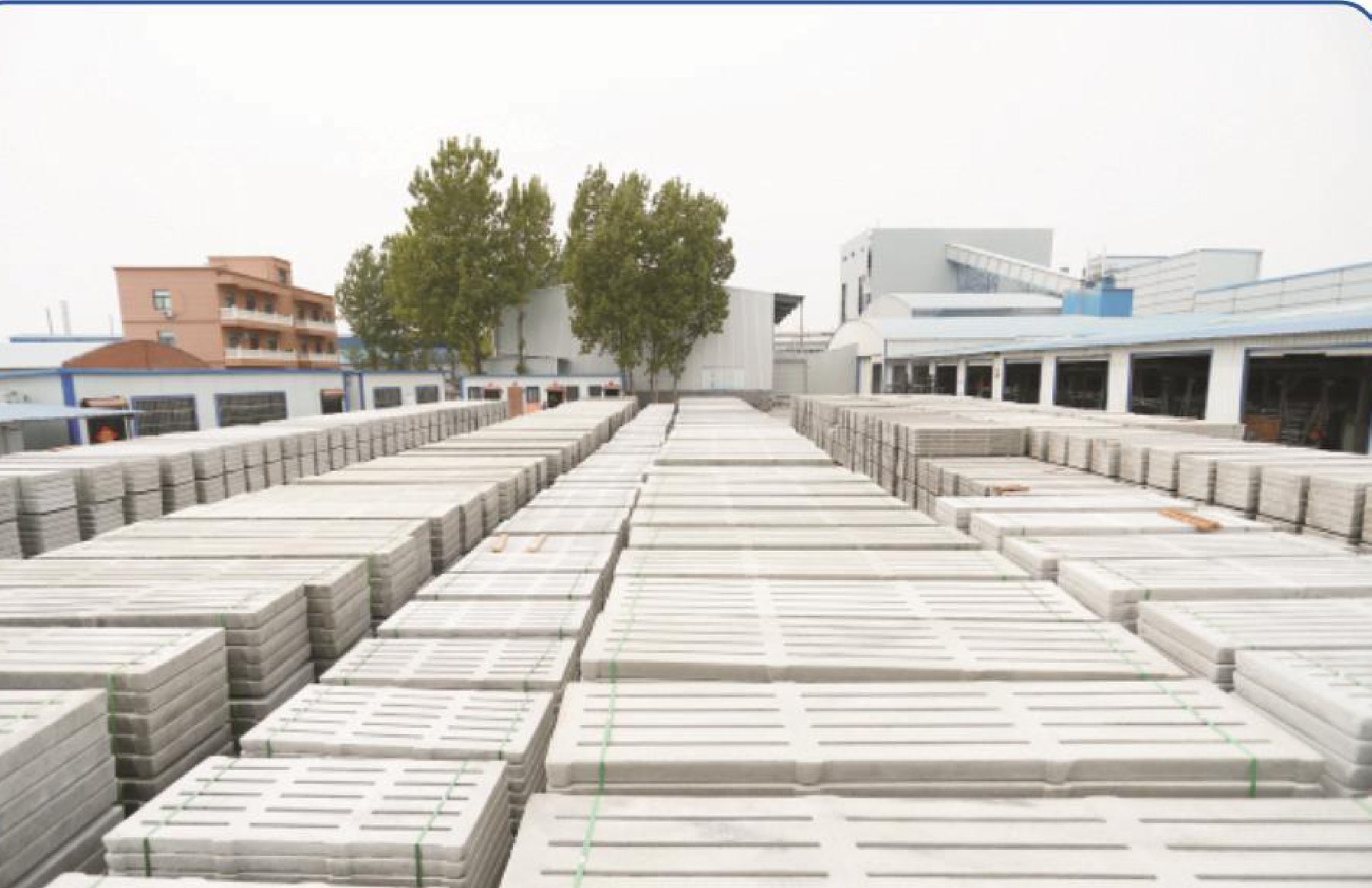
Concrete slats curing at the fifth production base.
A slat floor is the largest wear surface in a pig house. It carries every kilogram of live weight, every wash-down and every litre of urine for two decades, and it does so while sitting in the one place nobody wants to crawl into and inspect.
That is why floors fail quietly. By the time a producer notices, the failure is usually structural and the fix is a full-house replacement — the most expensive kind of maintenance there is.
The four ways a floor dies
- Corrosion of the reinforcement. Every concrete slat has steel inside it. If moisture and ammonia reach that steel, it expands as it oxidises and spalls the concrete from the inside out. This is the failure mode that decides most replacement cycles.
- Point-load deformation. A slat is a beam, not a plate. Under a 120 kg sow on a 600 mm span, the load path runs straight into the beam contact. Get the support spacing wrong and the panel creeps.
- Edge spalling. Sharp edges chip under hoof traffic and cleaning tools. Every chip widens the gap and every wider gap takes more of the next impact.
- Dimensional drift. Panels that expand and contract at different rates open gaps at the ends of the house and close them in the middle. Neither condition is good.
What the composite actually changes
Our BMC composite panels combine unsaturated polyester resin with glass fibre and an internal steel mesh. The mesh carries the bending load; the resin and fibre matrix carries the chemistry. Because the two jobs are separated, neither one has to be over-engineered to compensate for the other.
The surface is dense and non-porous. Urine does not soak in, so the panel does not become a reservoir for bacteria, and a pressure washer brings it back to the original colour instead of driving moisture deeper.
Expansion is the quiet killer
The thermal expansion coefficient of our composite sits at 1.3–1.5 ×10⁻⁵/K — five to ten times lower than a thermoplastic slat. In a 40 m house with a 40 K swing between a cold winter night and a wash-down, that difference is measured in centimetres of movement at the end walls.
Panels that move less can be laid tighter, and a tighter floor is a drier floor.
This is also why the material is rated for 280 °C and carries a flame-retardant rating. It is not because a pig house reaches those temperatures — it is because a floor that stays dimensionally stable under heat stress is a floor that will still fit its frame in year twelve.
The specification checklist
Before comparing prices, compare these five numbers. They determine the replacement cycle far more than the headline panel cost.
- Beam spacing against load class. A nursery panel and a gestation panel are not interchangeable, whatever the datasheet says.
- Gap width by weight class. Roughly 18–20 mm at weaning, opening to 22–25 mm for finishing pigs. Too wide and you lose the small animals; too narrow and the floor stops draining.
- Edge radius. Rounded edges survive cleaning tools and hooves. Square edges look tidy on day one.
- Surface texture. Enough grip to stop a sow slipping, not so much that it traps solids.
- Anchor type. Stainless fixings, or none at all. Galvanised anchors are the first thing to go.
What to ask a supplier
Ask for the thermal expansion coefficient, the strength retention figure after accelerated ageing, and the mould tolerance. A supplier who can answer all three is manufacturing to a specification. A supplier who answers only the first is selling a price.
Written by the KeMuHua engineering team · Xinxiang, Henan
All articles