Journal/Export
Southeast Asia is building farms. The next order is not for slats.
Vietnam's herd grew 2.2% in the first half of 2026 while 29 farms took 44.4% of its pork output. Consolidation changes what a customer wants to import: not a container of penning, but the plant that makes the floor. Here is the arithmetic that decides which one to ship.
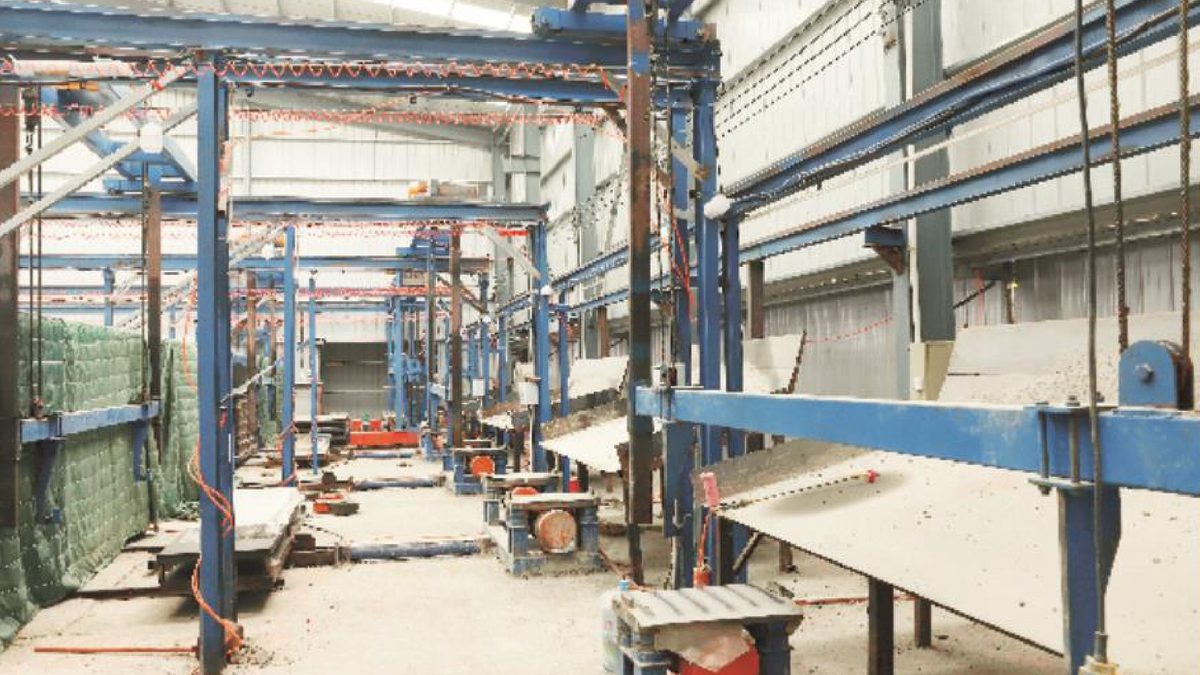
A concrete slat line is mostly a mould library and a gantry. The machine that vibrates is the cheapest part of it.
On 24 October lean hogs in Vietnam were quoted at VND 45,000 to 50,000 a kilogram. At 3,870 dong to the yuan that is RMB 11.6 to 12.9 — still RMB 2.4 to 3.6 above the Chinese national average of 9.28 the same week, after a 1.1% fall on the day. A spread that size, sustained, is why Chinese producers have started building south of the border rather than exporting into it. But the number that should decide what an equipment supplier puts in a container is a different one: twenty-nine farms in Vietnam now hold 30.5% of the national herd and produce 44.4% of its pork. That is not a market buying equipment. That is a market buying capacity, and the two are shipped differently.
The buyer changed before the shipping list did
Start with the shape of the market rather than its size. Vietnam’s pig herd grew about 3% a year between 2020 and 2025, and pork output rose from 4.01 to 5.39 million tonnes — 1.38 million tonnes of new supply in five years, recovered almost entirely from the 2019 African swine fever collapse. In the first half of 2026 the herd was still 2.2% up year on year and poultry 3.1% up, with livestock product exports at USD 375.8 million, 34.6% higher. On the headline numbers this looks like a growth market for equipment.
The distribution is what matters. Household farms are still the majority of producers, and that is precisely the problem the industry is trying to solve: backyard units carry the biosecurity risk that keeps re-seeding the virus, and they cannot absorb the cost of a closed house. Policy and credit have therefore pushed in one direction for six years — consolidation — and it is working faster than the aggregate statistics suggest. Twenty-nine operations now account for 30.5% of standing inventory and 44.4% of output, an output share 14 points ahead of their inventory share. Multinational producers hold an estimated 43% of the market. The rest of the herd sits in a very long tail that is being told, politely and then less politely, to become a contract grower or stop.
Vietstock closed in Ho Chi Minh City on 23 October with more than 300 brands and 13,000 trade visitors from over 40 countries. Almost all of them were selling finished goods — a fan, a crate, a nipple drinker, a controller. That is the correct thing to sell to a farm that is expanding one shed at a time. It is the wrong thing to sell to the twenty-nine, or to the integrator building for them, because those customers are not short of components. They are short of the ability to produce components locally, on a schedule that matches their construction programme.
A farm that adds a shed buys equipment. A company that adds a production base buys the means to make equipment — and those are two different export businesses with two different margin structures.
A slat has a radius, and it is shorter than the map
Take the single heaviest, cheapest, most repeatedly ordered item in a pig house: the concrete slat. A 600 by 2,400 mm panel at an effective 40 mm section weighs about 138 kg and covers 1.44 square metres, which works out at roughly 96 kg per square metre of floor. A 1,000-head finishing house with 0.75 square metres of slatted floor per pig needs 750 square metres, or about 72 tonnes of concrete.
Now load it. A 40-foot high-cube carries around 26.5 tonnes before it runs out of legal payload, and that 750 square metres occupies only about 30 cubic metres of the 76 available. The container is weight-limited, not volume-limited, which is the opposite of what most buyers assume and the reason “we will just pack it tighter” never works. Seventy-two tonnes is three containers, and no amount of loading discipline turns it into two.
Freight is nonetheless not the argument. Three 40-foot boxes from Tianjin or Shanghai to Cat Lai at USD 400 to 700 each add roughly RMB 11 to 20 per square metre — somewhere between a fifth and a third of what the panel itself is worth, depending on section and finish. That uplift is real, but a local plant does not escape it: it trades the freight for cement, aggregate, power, labour and mould depreciation, and the two bills land in the same order of magnitude. Anyone who tells you ocean freight alone is why slats should be made locally is selling you something. What does not cancel out is time.
- Breakage and replenishment. Slats break. A finishing floor loses a few percent of its panels over five years to loader damage, scraper impact and the occasional impatient boar. Every replacement is a 45 to 60 day ocean-plus-clearance cycle, during which a pen is either empty or patched with plywood. A local line delivers a replacement in three days.
- Construction sequence. A 20,000-head project in Binh Phuoc finishes floors before it finishes walls. If the slats arrive on a vessel after the roof goes on, the crane cannot reach the pens and the schedule slips a month. Local production decouples the floor from the shipping calendar.
- Classification. A finished concrete panel and a steel mould for making that panel do not sit in the same tariff line, and the ACFTA and RCEP schedules do not always treat them the same way. The difference is worth confirming against the current schedule before the enquiry, not after the quotation.
That yields a distance test rather than a sales pitch. Within about 800 kilometres of overland freight a finished slat is a truck away and nobody builds a plant to compete with it. Beyond that, every delivery is a sea voyage with a six-week clock attached, and the radius that matters is not geography but the replacement cycle. Every point in Southeast Asia is more than 800 kilometres from Henan.
Ten hertz is a 73% motor
Before the arithmetic of the line, there is a technical reason why a complete production line cannot simply be built in Henan, tested, and shipped intact. Southeast Asia is not one electrical standard.
Vietnam runs 220 V at 50 Hz. Thailand, Indonesia and Cambodia run 230 V at 50 Hz. Malaysia and Singapore run 415 V three-phase, not the 380 V a Chinese panel is wired for. The Philippines is the outlier and the one that breaks equipment: 220 V single-phase, 440 V three-phase, and 60 Hz throughout, with 110/120 V still present in older districts.
Ten hertz is not a rounding error on a motor. A four-pole machine at 50 Hz turns at 1,500 rpm; the same machine on 60 Hz turns at 1,800. That is 20% more speed, and for a fan or a pump the affinity laws apply: flow rises with speed, pressure with the square, and shaft power with the cube. 1.2 cubed is 1.728. A vibration-table motor or a curing-tunnel fan specified at 50 Hz draws 73% more power on 60 Hz mains, at a current the winding was never designed for, through a contactor sized for the old figure. It does not fail on commissioning day. It fails in the third month, in a country where the spare is eight weeks away.
The same error runs the other way. A 60 Hz motor on 50 Hz mains loses 17% of its speed and, for a constant-torque load, saturates its magnetic circuit and pulls up to 1.2 times its rated starting current. Either direction, the fix is the same and it is not a transformer.
So the line is designed as two shipments. The steel — gantry, mould frames, pallets, curing racks, batching skip — is fabricated and painted in Henan, where the welding and the galvanising are. The motors, gearboxes, contactors, thermal overloads and heater bands are bought in the destination country against its own voltage and frequency, and the control cabinet is wired to a drawing that names 440 V / 60 Hz or 415 V / 50 Hz at the top. A Chinese panel shipped as-is into Manila is a warranty claim waiting for a date.
Export the structure and the tooling. Buy the electrics where the electricity is. It sounds like a procurement detail; it is the difference between a line that runs for ten years and a line that runs until the first summer.
What a line actually is
Buyers consistently over-weight the vibrating table and under-weight everything that decides output. A concrete slat line has seven stages: aggregate and cement batching, mixing, cloth or liner laying, vibration and compaction in the mould, strike-off, demoulding onto a pallet, and curing before the pallet is released for the next cycle. Add a gantry or a transfer car to move pallets, and a palletising station if the plant is selling outward rather than feeding its own site.
The machine that shakes is one item on that list. The binding constraint is almost always the mould library, because curing time is fixed by chemistry and cannot be compressed by buying a bigger vibrator. Work it through for a plant targeting 300 square metres a day in 1.44 square metre panels: that is 208 panels, or 52 mould cycles if each mould carries four. At a 20-hour cure, with the mould unavailable for the whole of it, the plant needs at least 44 mould sets in circulation before it can hit the target — more if the shift pattern is single and the demoulding is manual.
Forty-four sets of steel moulds is the capital in the project. It is also the item that gets cut when a buyer negotiates, and cutting it does not reduce the price of the plant — it reduces the output, which is the only thing the plant was bought for. A line quoted at 300 square metres a day on 20 mould sets is a 140 square metre a day line with a 300 square metre price.
The payback argument is then short enough to write on one page, and it has exactly three inputs a buyer has to supply: the landed cost of an imported slat per square metre, the local cost of cement, aggregate, reinforcement, labour and power, and the number of square metres the buyer will lay in the next three years. Nobody can fill the first two in from China. What we can say is where the crossover usually lands: a line sized to a single 10,000-head project is marginal, and a line sized to a 20,000-head programme or to a contractor serving several of them is not.
The three local variables nobody quotes
Every line quotation is written against a cement, an aggregate and a climate that may not be the ones at the site. These three decide whether the plant reaches its rated output in month one or month seven.
Cement. Vietnam supplies PCB40 to TCVN 6260; the Philippines uses Type 1P and Type 1 under PNS; China pours P.O 42.5. The designations are close but the strength-gain curves are not identical, and the demoulding time in the cycle is set by early strength, not 28-day strength. A mix designed on Chinese cement and re-run on a slower early-strength product either needs an admixture or needs a longer cure — and a longer cure means more moulds, which is the expensive answer.
Aggregate. River sand with a clay and silt content above 3% loses both strength and surface finish, and the failure mode is not a weak slat but a sticky one: it tears at the mould edge on demoulding and the reject rate climbs quietly. Coastal plants in Vietnam and the Philippines reach for sea sand when river sand is short, and sea sand brings chloride. For unreinforced or pretensioned sections the chloride question is different from a reinforced beam, but it is a question that has to be answered in the mix design rather than discovered in year four at the slat edge.
Curing. Here the tropics are an advantage and a trap at once. At 30 °C and 65% to 85% relative humidity, early strength develops faster than in a Henan winter, and demoulding can come down to 12 to 16 hours, which cuts the mould library by about a third. The trap is evaporation: a 30 °C day with a breeze dries a fresh face faster than a cold one, and plastic shrinkage cracks appear on the top surface where the pig will stand. Covering and misting for the first six hours is not optional in the tropics; it is the same discipline as winter protection, run for the opposite reason.
What to put in an enquiry
An enquiry that arrives with these eight items gets a layout, an equipment schedule and a floor price in one reply. One that arrives with “a slat line, please” gets a question sheet and loses two weeks.
- Target output in square metres per day, and whether the plant feeds one project or sells to third parties. These are different plants.
- Panel size and section, drawn, with the slot width and the reinforcement or pretensioning specified. The mould is cut to the drawing, once.
- Grid: voltage, phase and frequency at the site, and whether the supply is stable enough for a batching plant or needs a stabiliser.
- Cement type and source, with the datasheet. Not the grade — the actual product.
- Aggregate source, with a sieve and a silt test. Two numbers that predict the reject rate better than any other input.
- Site footprint, and whether curing is indoor or in the yard. Yard curing through a monsoon needs a different pallet count.
- Who will operate it, and whether the buyer wants an operator on site for commissioning. The line will run on day one either way; it will run at rate in month six only if someone owns the mix.
- Spare-parts expectation. Mould edge strips, liner sheets, vibrator bearings and limit switches wear. A ten-year plant needs a parts list, not a promise.
Why we are writing this instead of quoting it
We make the slats, and we make the lines and the moulds that make the slats. That combination is unusual enough that it obliges us to be honest about which one a customer should buy, because the answer is genuinely different in Da Nang and in Xinxiang.
For a single 1,000-head house, ship the floor. It arrives finished, and the freight is not the obstacle people imagine. For a 20,000-head programme, or for a contractor who intends to supply the projects around him, ship the plant — the structure, the mould library, the gantry and the drawings — and buy the motors where the grid is. That is not a larger order for the sake of being larger. It is the same order, addressed to a different bottleneck.
The reason to say so publicly is that the second kind of order is the one Southeast Asia is about to place. Twenty-nine farms already hold a third of Vietnam’s herd. The next hundred will be built by companies that intend to build more than one, and a company building its third project does not want a fourth container of somebody else’s floor. It wants a mould, a mix design and a phone number that answers in the same time zone.
That is a harder thing to sell than a crate. It is also the only part of this trade that compounds.
Written by the KeMuHua engineering team · Xinxiang, Henan
All articles