Journal/Export
A million cows are on the manifest. The barn is a three-cow kit.
Indonesia wants to import a million dairy cows in five years and quadruple its milk output. In 2025 it landed 13,544. The reason is not the cows. It is that 77 per cent of the country's milk comes from households with three cows, and nobody sells equipment to a three-cow household. Here is what that order actually looks like.
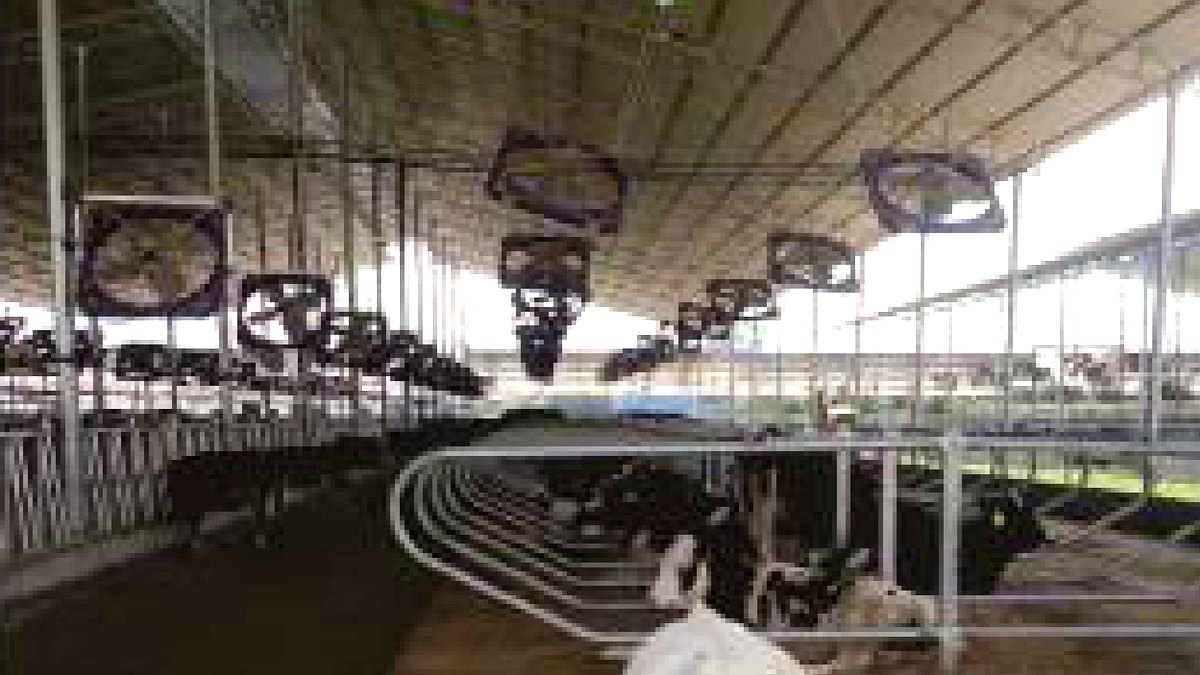
Circulation fans along the lying area of an open-sided dairy barn. In the tropics the fan is there to move air across a cow at 1.5 m/s, not to exchange the volume of the building.
In September, 1,383 dairy heifers came off a ship at Cilacap on the south coast of Central Java, went into fourteen days of quarantine and were sampled for lumpy skin disease and foot-and-mouth. Two private importers paid for them: 1,094 head for Lunar Chemplast, the balance for Mazaraat Lokanatura. It is a modest consignment, a little over a tenth of the 13,544 dairy cattle Indonesia imported in all of 2025, and it sits inside a national plan to bring in one million head over five years, worth about USD 3 billion, with the stated aim of quadrupling domestic milk output. The gap between 1,383 and a million is the whole story. It is not a shipping problem and it is not a financing problem, although both are real. It is that the receiving end of that plan is not a farm. It is 333,000 households with three cows each, and the equipment industry has no product for them.
First, the two population numbers, because they disagree by a factor of two
Official reporting in September put Indonesia’s dairy herd at about 220,000 head. The Central Statistics Agency’s own series has the national dairy cattle population between 346,000 and 611,000 across 2000 to 2024, never once above a million, and recorded roughly 500,000 in 2023 after a 12.9% fall. Those two figures are not a typo in either direction. The smaller number is milking animals; the larger is all dairy cattle including heifers, calves and dry cows. The distinction matters commercially, because a heifer that lands in Cilacap this month is not a milking cow this month, and every equipment decision downstream depends on which of the two numbers the project is being sized against.
Take the honest middle. Indonesia has somewhere between half a million and six hundred thousand dairy cattle, of which roughly four in ten are in milk at any time, producing around one million tonnes of fresh milk a year against demand near 4.7 million tonnes. About 79% of dairy requirement is imported, and domestic production covers roughly a fifth of what the country consumes. The free nutritious meals programme, which is the political engine behind all of this, is designed to reach 82.9 million children and pregnant women; through 2025 it had reached about 20 million. Every one of those meals that includes milk is a demand signal that the domestic herd cannot currently answer.
A country that imports 79% of its dairy does not have a cow problem. It has a collection, cooling and housing problem wearing a cow costume.
The plan is running at seven per cent, and that tells you what to sell
The 2025 target was 200,000 head. It was cut to 150,000 in September. By May, about 9,700 had arrived. The full year closed at 13,544 dairy head, roughly 6.8% of the original number. There are several explanations, and the deputy minister gave the diplomatic one — that investors from Vietnam and Brazil still needed confidence in the local investment climate — but the operationally useful explanation is that the government has been asking private companies to buy the cattle, which means the animals arrive only as fast as somebody can build somewhere to put them.
That is the part the equipment trade keeps misreading. A one-million-cow headline invites a one-million-cow pitch: a 2,000-head rotary parlour, a total mixed ration plant, a lagoon. Those projects will exist, and a handful already do, mostly attached to the corporate farms that supply the big processors. But the 2026 flow is 1,383 head into Cilacap for two private importers, and 1,383 head divided by three cows per household is 461 households. That is the order. Not one project of a thousand cows. Four hundred and sixty-one small ones, arriving overland on a truck, into barns that already have a roof and a concrete floor and a farmer who has been keeping cattle since before the importer was born.
Scale that to the plan and the arithmetic gets uncomfortable in a useful way. One million head at three per household is 333,000 sites. Spread over five years that is 182 installs a day, every calendar day, across an archipelago 5,000 kilometres wide. No manufacturer can put a technician on 333,000 sites. Any product that requires one is not a product for this market, and the entire commercial question collapses into a single specification: can two people with a spanner and a drawing fit this in an afternoon, and can the spare part be found in a cooperative warehouse in Malang.
The freight is trivial, which is the first surprise
Suppliers assume the obstacle is shipping. It is not. Price the hardware per cow and the container mathematics come out almost too easy: cubicle dividers, a headrail, one bowl, a length of trough and a share of a fan add up to roughly 25 kilograms of steel and plastic per cow. A million cows is 25,000 tonnes. A 40-foot high cube carries 26.5 tonnes. That is about 940 containers over five years, or four a week, or one every working day and a half. For comparison, the same number of containers of concrete slats would be several times heavier per unit of value and would hit the weight limit before the volume one.
So the freight is not the constraint, the production capacity is not the constraint, and the steel price is not the constraint. The constraint is that a 25-kilogram kit is the wrong shape. A container of loose penning needs a welder, a level floor and a decision at the other end. A container of flat-packed, pre-drilled, jig-made kits with a numbered drawing fits a household that has a wall, a hammer and two sons. The difference between those two shipments is not the bill of materials. It is about six weeks of design work and a decision to stop selling projects.
Why the barn in the photograph is the wrong reference
Look at the image at the top of this page. It is a good barn. Open sided, steel frame, cubicles in rows, circulation fans on a drop-rod line above the lying area so that a standing animal is always in moving air. It is also, at roughly 200 head, about sixty-six times the size of the unit that this market is actually buying, and almost nothing about its design logic transfers downward without being re-derived.
Start with the fans, because they are the item most often specified wrongly from a Chinese or European template. A pig house is a closed, insulated, negative-pressure box, and its fans are sized to exchange the volume of that box a given number of times per hour. A tropical dairy barn is an open-sided shed with no meaningful static pressure and no useful air exchange figure. What matters there is air speed at the cow. The published target is at least 200 feet per minute, which is about 1.0 metre per second, across the resting area, and the reason it is expressed as a floor rather than a ceiling is that a lying cow cannot pant her way out of a humid afternoon — she needs moving air over her hide, and she needs it in the twelve to fourteen hours a day she spends lying down.
Which produces a specification that looks nothing like a ventilation system. Fans at 1.2 to 1.4 metres diameter on a horizontal line above the cubicles, spaced so that the cones overlap rather than leaving gaps between two streams, mounted at 2.4 to 2.8 metres so the jet reaches the cow's back rather than her ears, and sized for 1.5 metres per second at the animal rather than 1.0, because the target is a floor for a temperate summer and Java in October is not a temperate summer. Thirty years of exporting negative-pressure equipment has not prepared anybody for a product whose performance metric is a number in metres per second at a height of one metre.
Then the water, and this is where the smallholder kit earns its keep. A lactating cow at 20 litres of milk a day drinks 60 to 100 litres, and in a heat event that multiplies by one and a half to two, so the design case for a three-cow household is 400 to 600 litres on the worst day of the year. That is not a bucket. It is a 200-millimetre pressed bowl with a guard, at 700 to 800 millimetres above the floor, fed by a half-inch line that delivers 10 to 20 litres a minute, because a cow takes two or three very large draughts and will not stand at a slow bowl for four minutes in the sun. Get the flow rate wrong and the failure is invisible: a dominant cow owns the bowl, a subordinate drinks less than she needs, and the household loses a litre and a half a day without ever seeing a symptom.
The floor question, and why the pig answer is a trap
Indonesian smallholder barns are overwhelmingly tie-stall or simple loose housing on concrete, which is closer to correct than most suppliers expect. Where the pig playbook gets imported, it goes wrong in a specific way. A slatted floor is a dung-management solution for an animal that weighs a hundred kilos and stands on a soft hoof. A Holstein weighs six hundred and stands on a hard one whose contact patch is twelve to fifteen centimetres across, and when she rises — which she does, thirty to forty times a day — the load on one hind hoof briefly carries most of the animal with a dynamic factor of one and a half to two. An 18 to 25 millimetre slot is a trap for that hoof, and a composite slat rated for a finisher is a fatigue test nobody specified.
What a dairy cubicle actually needs is the opposite of drainage. A solid, grooved surface with a fall of 1.5 to 2% toward the alley, a 0.20 metre kerb at the rear, and enough length that a cow can lunge forward when she stands: 2.4 to 2.6 metres for a Holstein, at 1.15 to 1.25 metres centre to centre, with the headrail at 1.20 metres. Below that length the cow lies diagonally or perches with her hind feet in the alley, and both of those are a lameness diagnosis waiting to be written. Above it, the cubicle wastes 200 millimetres of a building the household paid for by the square metre.
Bedding is the other half and it is a supply-chain question before it is an engineering one. Sand is the best surface and the worst manure system, because it settles in the pit and destroys pumps; sawdust and rice straw work and are locally available, which in a village is the only criterion that survives contact with a budget. The compromise that works: a 100-millimetre sawdust or straw bed over a solid base, topped daily, with a 250-millimetre sand-filled mattress where the household can get sand. Either way the cow lies down twelve hours a day, and that is where the milk is made, not in the parlour.
Cut and carry inverts the feed line
Almost every design rule in this industry assumes a total mixed ration wagon arrives twice a day and needs three metres of clear alley to do it. In Java it usually does not. Smallholders cut and carry: forage is chopped and brought to the barn by handcart or motorbike, and the feed face has to work for a person standing in front of it with a basket, not for a machine driving past it.
The consequences are small, cheap and decisive. Trough height 600 to 700 millimetres, so a standing person can tip a basket into it without lifting above the shoulder. A feed face of 0.65 to 0.75 metres per cow, which for three cows is a 2.0 to 2.25 metre trough and not a 1.5 metre one, because a cow that cannot reach her allocation eats last and eats least. An alley of 2.0 to 2.5 metres, which is exactly the dimension a TMR barn would reject as too narrow and exactly the dimension a handcart needs. And a trough profile with a raised lip and a smooth inner face, because the alternative is 30% of the forage swept onto the floor and hosed away.
The Chinese mega-farm and the Javanese smallholding are not the same product at different scales. They are the same animal in two different buildings, and only one of those buildings is designed around a machine.
The economic argument is reproduction, not milk yield
Heat stress sells badly when it is presented as a yield problem, because a household producing 8 to 10 litres a day already discounts the loss as normal. It sells well when it is presented as a calving-interval problem, and the Indonesian evidence for that is stark: work on repeat breeding in smallholder herds has recorded prevalence as high as 62% in one South Sulawesi district, against a 5% to 36% range reported worldwide. Every case is a cow that has failed to hold a pregnancy at least three times running. She is not a cow producing slightly less this month. She is a cow producing nothing next year, and she is still eating.
Run the arithmetic on one household. A missed cycle is 21 days open, and at 15 litres a day that is 315 litres, which at Rp 5,500 a litre is Rp 1.73 million — about RMB 745. Now price the intervention. A fan line, a bowl at the right height with the right flow and a shaded lying area come to somewhere between RMB 1,800 and RMB 2,400 per household at three cows, call it RMB 2,100. If that recovers 2.5 litres a day across the 200 days of the hot season — a deliberately conservative read of the published heat-stress response curves — it is 500 litres, or RMB 1,180. On milk alone that is a payback of twenty-one months, and twenty-one months is not a sale.
Add one recovered conception and the payback is thirteen months. Add the second one that the 62% figure says is probably also being lost and it is nine and a half. That is the version of the number a cooperative loan committee will approve, and notice what it does not require: not a higher peak yield, not a better cow, not a new barn. It requires the cow to calve on the interval she was already capable of, which is the cheapest increase in output available on a farm that measures its year in litres rather than in head.
That is the only version of this sale that survives a smallholder's own arithmetic, and it is why the pitch has to be a kit and not a project. A project has a feasibility study. A kit has a payback period short enough that a farmer with three cows and a cooperative loan can compute it on a phone.
What we would actually put in the container
We are writing this because we make exactly the twelve families that a barn like this needs and none of them is exciting: neck locks and cubicle dividers, cattle troughs to any length, bowls, fans, and the penning and flooring hardware that holds the whole thing together. What we do not have, and would need to build, is the packaging. So here is the honest version of what we think the order looks like, stated as a specification rather than a pitch.
- A six-cow kit as the base unit, not a three-cow one. Three cows is the average, six is the working household with a calf pen and a dry cow. One kit, one crate, one drawing, one invoice, and it must scale by doubling rather than by re-quoting.
- Flat-packed and pre-drilled, with a numbered drawing in Bahasa Indonesia. Not translated English. Numbered, with the torque values on the sheet, because the installation is being done by the household and the drawing is the only supervision available.
- Galvanised to a coating class that survives 85% relative humidity, not a class chosen for Henan. This is the one place where a Chinese-specification part fails visibly and quickly in the wet season, and it fails at the weld, not in the middle of the tube.
- Fans specified in metres per second at cow height, and supplied with the mounting hardware for a drop-rod line. A fan that arrives with a wall bracket has arrived with the wrong bracket.
- Bowls with a stated flow rate and a service kit of seals and a float. The seal is the part that fails, it fails in year two, and if it has to be imported the household goes back to a bucket.
- A single spare-parts crate per cooperative, not per site. There are 333,000 sites and perhaps 1,600 cooperatives. Stocking the cooperative is the only distribution model with a service level that means anything.
None of that is a technical problem, which is what makes it frustrating. The steel is the same steel. The fan is the same fan. What changes is that a business built on quoting thousand-head houses has to learn to ship the same value in six-cow increments, print a drawing, and accept that the customer is a person with a wall and a hammer rather than a project manager with a purchase order.
Why this is the third note we have written about Southeast Asia
We wrote in October about the specification thresholds that decide whether equipment survives a tropical site, and then about a market that has stopped buying containers of penning and started buying the plant that makes the floor. This one is the third bottleneck, and it is the least flattering to us, because it is about the size of the customer rather than the quality of the product. A market of 333,000 three-cow barns will not be served by whoever builds the best 2,000-head rotary parlour. It will be served by whoever can put a flat crate on a truck in Surabaya on a Tuesday and have it standing up in a barn by Friday, with the drawing still readable after the rain.
The cows are coming, a thousand or fourteen hundred at a time, and slowly enough that the barns can be built first if anyone chooses to. On the current rate Indonesia will import its millionth dairy cow some time in the 2040s, not in 2029. That is not an argument against the market. It is an argument that the market is a retrofit market, available now, and that the first supplier to work out the three-cow crate will not have much competition, because the rest of the industry is still quoting thousand-head projects to a country that is landing them by the thousand head.
Written by the KeMuHua engineering team · Xinxiang, Henan
All articles