Journal/Climate
Negative-pressure ventilation: sizing the fan bank to the house
Most under-ventilated houses are not short of fans. They are short of inlet area.
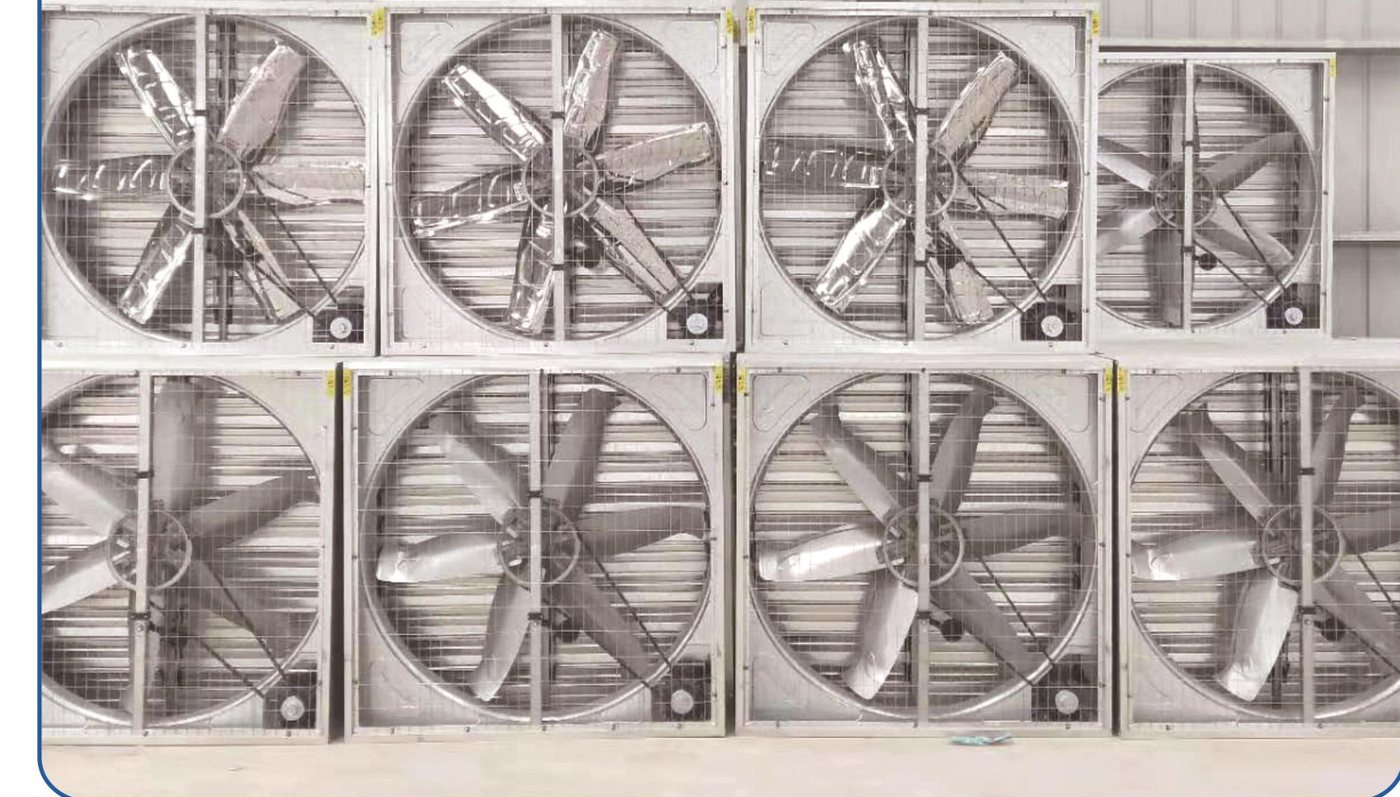
Galvanised negative-pressure fan bank with automated louvres.
When a house runs hot and humid, the instinct is to add another fan. In most of the buildings we are called out to, the fan bank is already the right size — what is missing is the opening that lets air in.
Static pressure is the whole design
A negative-pressure system works by holding the house at a small vacuum, typically 10–25 Pa, so that incoming air enters at speed, travels along the ceiling, mixes and drops without landing on the animals. Get the inlet area wrong and the pressure collapses: air dribbles in, drops straight down, and the house stratifies into a hot ceiling and a wet floor.
Adding fan capacity to a house with too little inlet area does not fix this. It lowers the pressure further and makes the short-circuit worse.
Sizing in the right order
- Air exchange rate by weight class and season, in m³/h per animal.
- Total house demand at the summer maximum.
- Fan count and diameter to meet it, with one unit of redundancy.
- Inlet area, sized to the fans — not to the wall.
Housing choice: FRP or galvanised
Both are in our range because they belong in different buildings. Glass-fibre housings resist ammonia and wash-down chemical attack and hold their shape in a corrosive atmosphere; galvanised steel housings are the economical choice where the fan sits outside the dirty zone or where impact resistance matters more than corrosion resistance.
What matters in both cases is the impeller and the shutter. A fan is a moving part in a wet, dusty, ammonia-rich environment, and the bearing and louvre mechanism is what actually determines its service life.
Beyond the fan bank
- Cooling pads. Effective in dry heat, close to useless in high humidity — a pad that cannot evaporate is a wet wall.
- Heat panels. Composite electric panels for creep areas, where the goal is a warm floor rather than warm air.
- Insulated boxes. For piglets, the box holds the microclimate that the house ventilation is deliberately trying to keep cool.
- Odour curtains. A wet curtain at the exhaust is a cheap way to knock down dust and ammonia before the air leaves the site.
Ventilation is a system of openings and fans. Most of the failures live in the openings.
Three things to check before you buy another fan
Measure the static pressure with the house closed. Measure the actual inlet free area, not the frame size. And check whether the fan shutters are sealing — a shutter that hangs open two centimetres is a permanent short-circuit that no amount of capacity will fix.
Written by the KeMuHua engineering team · Xinxiang, Henan
All articles